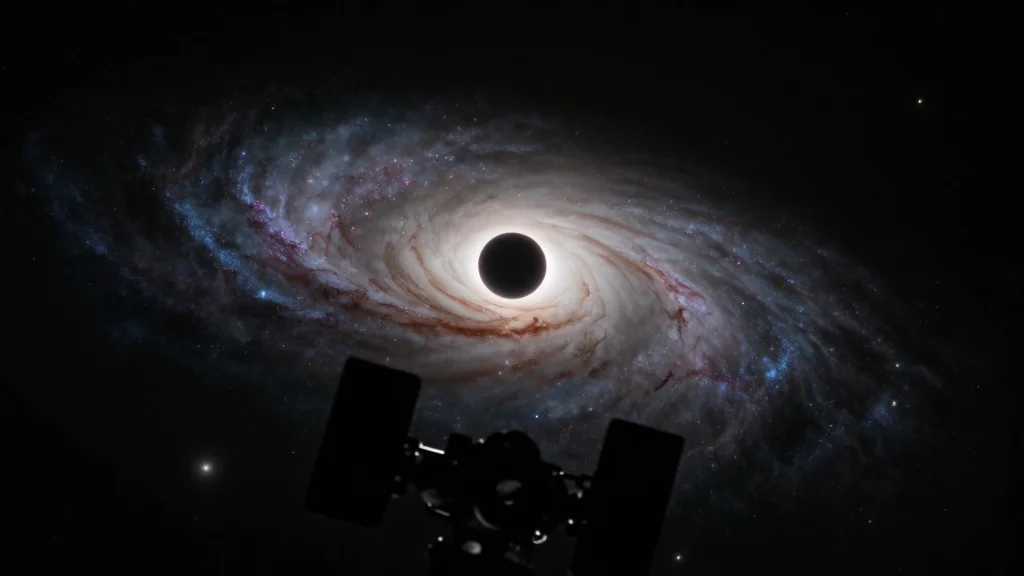
JWST Finds Most Distant Dormant Black Hole, 6 Billion‑Solar‑Mass Object 10 Billion Light‑Years Away

Why It Matters
The detection provides the first direct measurement of a supermassive black hole’s mass at a time when the universe was less than a quarter of its current age. By confirming that stellar‑dynamics can be applied at such distances, the study unlocks a powerful tool for probing black‑hole demographics in the early cosmos, a regime previously accessible only through indirect signatures. This has immediate implications for models of galaxy formation, which must now account for the possibility that massive black holes could already have exerted a regulatory influence on their hosts. Moreover, the result bridges a critical observational gap between the well‑studied local universe and the high‑redshift epoch explored by JWST’s deep‑field surveys. As more dormant black holes are catalogued, astronomers will be able to test whether the black‑hole–galaxy mass relation is universal or evolves over time, refining our understanding of the physical processes that shape cosmic structure.
Key Takeaways
- •JWST measured a 6 billion‑solar‑mass dormant black hole in galaxy MRG‑M0138.
- •The galaxy lies >10 billion light‑years away, showing the universe at ~3 billion years old.
- •Stellar dynamics, previously limited to 700 million light‑years, was applied at this distance.
- •Gravitational lensing magnified the target by ~30×, enabling the measurement.
- •Findings suggest early‑universe black holes may have quenched star formation in their hosts.
Pulse Analysis
The breakthrough underscores JWST’s role as a transformative instrument for extragalactic astronomy. By extending stellar‑dynamics—a technique traditionally confined to the local universe—into the epoch of peak galaxy assembly, the telescope is reshaping the methodological toolkit available to researchers. Historically, black‑hole masses at high redshift have been inferred from active galactic nuclei luminosities or indirect scaling relations, both of which carry substantial uncertainties. Direct dynamical measurements, even for a single object, provide a benchmark that can calibrate those indirect methods.
From a competitive standpoint, the result positions JWST ahead of other upcoming facilities such as the European Extremely Large Telescope (ELT) and the Nancy Grace Roman Space Telescope, which will also aim to resolve early‑universe black holes but lack JWST’s current infrared sensitivity and resolution. The study’s reliance on strong gravitational lensing highlights a strategic synergy: future surveys that map massive foreground clusters will become essential hunting grounds for similar measurements. As the sample grows, statistical analyses will either confirm the early establishment of the black‑hole–galaxy mass relation or reveal a more complex evolutionary path, potentially prompting revisions to semi‑analytic models of galaxy formation.
Looking forward, the discovery raises several open questions. Does the quenching effect inferred for MRG‑M0138 represent a common phase for massive galaxies, or is it an outlier? How rapidly did supermassive black holes reach billions of solar masses in the first few hundred million years after the Big Bang? JWST’s continued spectroscopic campaigns, combined with next‑generation X‑ray observatories, will be crucial for answering these questions and for mapping the full demographic landscape of black holes across cosmic time.
JWST Finds Most Distant Dormant Black Hole, 6 Billion‑Solar‑Mass Object 10 Billion Light‑Years Away
Comments
Want to join the conversation?
Loading comments...