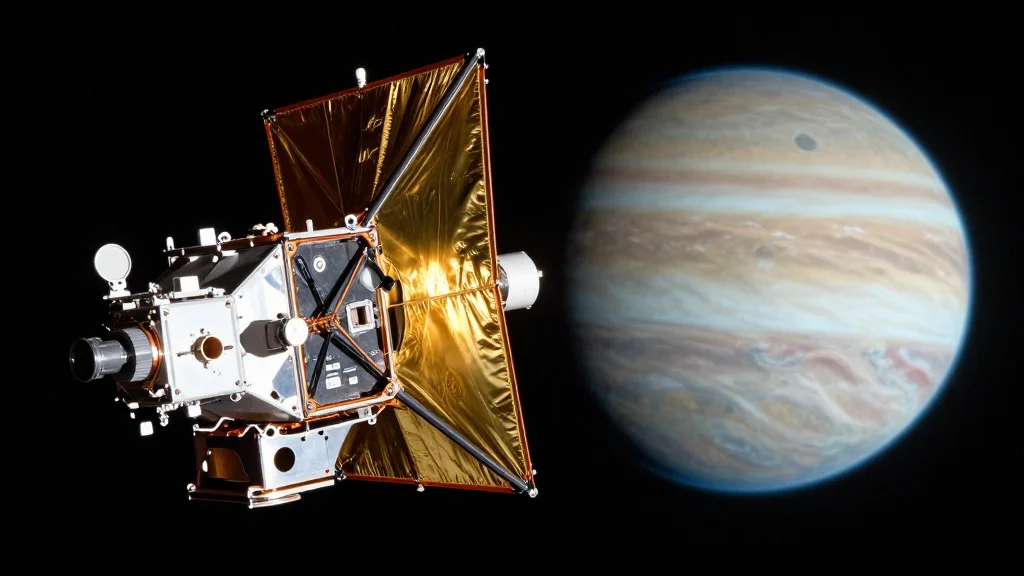
JWST Finds Water‑Ice Clouds on Epsilon Indi B, Upending Giant Planet Models

Why It Matters
The observation of water‑ice clouds on a cold, Jupiter‑like exoplanet forces a reassessment of atmospheric chemistry across a wide swath of known giant planets. If ice clouds can dominate the upper atmospheres of such worlds, models used to infer composition, temperature structure, and even formation histories may need substantial revision. This has downstream effects on how scientists prioritize targets for future telescopes, especially those seeking biosignatures on temperate, Earth‑size planets, where cloud opacity can mask or mimic key spectral features. Moreover, the success of direct imaging with JWST’s mid‑infrared instrument expands the toolkit for exoplanet characterization beyond the transit method. It demonstrates that even planets on wide orbits, previously out of reach, can be studied in detail, paving the way for a more complete census of planetary atmospheres and informing the design of next‑generation observatories such as the Habitable Worlds Telescope.
Key Takeaways
- •JWST’s MIRI instrument directly imaged water‑ice clouds on Epsilon Indi b.
- •The planet’s mass is now estimated at 7.6 Jupiter masses, with a Jupiter‑like diameter.
- •Ice clouds mask expected ammonia signatures, challenging existing atmospheric models.
- •Direct imaging of a cold, long‑period giant expands exoplanet study beyond transits.
- •Follow‑up observations and revised cloud models are planned to refine atmospheric retrievals.
Pulse Analysis
The detection of water‑ice clouds on Epsilon Indi b is a watershed moment for exoplanet science, not because it confirms a long‑held hypothesis, but because it reveals a blind spot in the community’s modeling toolbox. For decades, atmospheric retrievals have leaned heavily on Jupiter and Saturn as analogues, assuming that ammonia clouds dominate at temperatures below 250 K. JWST’s data shows that, at least for a 7.6‑Jupiter‑mass world orbiting a cooler star, water‑ice can form high‑altitude, optically thick layers that effectively hide ammonia. This forces a paradigm shift: cloud microphysics must now account for a broader range of condensates, particle sizes, and vertical mixing processes.
From a strategic perspective, the result validates JWST’s direct‑imaging capability as a complement to transit spectroscopy. Historically, the exoplanet field has been dominated by the transit method, which biases samples toward hot, close‑in planets. By successfully characterizing a cold, wide‑orbit giant, JWST demonstrates that the community can now access a more representative slice of planetary diversity. This will likely influence the target selection for upcoming missions like the Nancy Grace Roman Space Telescope’s coronagraph and the proposed Habitable Worlds Telescope, which aim to image Earth‑size planets in reflected light. Understanding cloud behavior on giants is a prerequisite for interpreting the much fainter signals from terrestrial worlds.
Looking ahead, the immediate challenge is to integrate water‑ice cloud physics into retrieval frameworks and to test whether similar cloud decks exist on other cold giants such as 51 Eridani b or HR 8799 c. If ice clouds prove common, they could become a dominant source of opacity in the mid‑infrared, reshaping expectations for the detectability of key molecules like methane and phosphine. The broader implication is clear: as we push toward the ultimate goal of detecting biosignatures, mastering the cloud problem on all planetary classes will be essential, and JWST’s latest discovery is a crucial step on that path.
JWST Finds Water‑Ice Clouds on Epsilon Indi b, Upending Giant Planet Models
Comments
Want to join the conversation?
Loading comments...