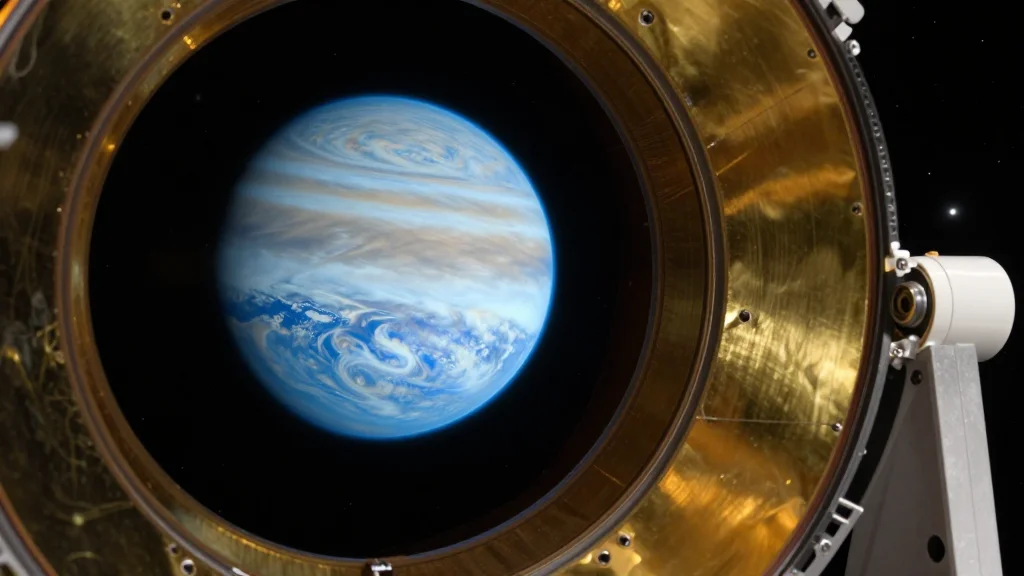
JWST Finds Water‑Ice Clouds on Nearby Exoplanet Epsilon Indi Ab

Why It Matters
Detecting water‑ice clouds on a true Jupiter analogue forces a reassessment of how heat and chemistry are regulated in cold gas giants, a class of planets that dominates the galaxy’s planetary census. The finding narrows the gap between exoplanet science and Solar System studies, offering a tangible laboratory for testing cloud‑microphysics that also applies to brown dwarfs and, eventually, temperate terrestrial worlds. Beyond theory, the result demonstrates the power of JWST’s mid‑infrared coronagraphic imaging to access planets that elude transit surveys. This methodological breakthrough expands the target list for atmospheric characterization, accelerating the roadmap toward detecting biosignatures on Earth‑size planets orbiting nearby stars.
Key Takeaways
- •JWST’s MIRI instrument directly imaged Epsilon Indi Ab, revealing water‑ice clouds.
- •The planet’s mass is 7.6 times Jupiter’s while its diameter is comparable to Jupiter’s.
- •Observed ammonia absorption is shallower than predicted, indicating cloud masking.
- •Findings challenge existing cold‑giant atmospheric models and align with brown‑dwarf data.
- •Direct‑imaging approach opens atmospheric studies of wide‑orbit exoplanets previously inaccessible.
Pulse Analysis
The ice‑cloud discovery marks a pivot point for exoplanet atmospheric science. For over a decade, most atmospheric work focused on hot Jupiters because their transits are easy to capture. Those planets, heated to thousands of kelvin, have atmospheres dominated by chemistry that bears little resemblance to the cooler giants in our own system. By finally accessing a cold, Jupiter‑mass world, JWST forces modelers to incorporate cloud microphysics that were previously relegated to brown‑dwarf studies. The convergence of exoplanet and substellar object data suggests a unified framework may be emerging, where water‑ice and sulfide clouds dominate at temperatures below 300 K.
From a strategic perspective, the result validates the investment in high‑contrast coronagraphy and mid‑infrared spectroscopy. It also underscores a limitation: while JWST can now resolve cloud decks on a handful of nearby giants, scaling this capability to the dozens of temperate super‑Earths that will be discovered by missions like PLATO and the Roman Space Telescope will demand higher‑contrast instruments and longer baselines. The upcoming Habitable Worlds Observatory, with its planned 6‑meter aperture and advanced coronagraph, is poised to build on JWST’s legacy, turning cloud detection from a novelty into a routine diagnostic.
In the longer term, the presence of ice clouds may affect the thermal evolution of gas giants, influencing how quickly they cool and contract. If such clouds are common, they could bias mass‑radius relationships derived from indirect methods, prompting a re‑examination of population‑level studies that inform planet formation theories. As the community gathers more spectra of cold giants, the field will likely see a wave of revised models that integrate cloud opacity, vertical mixing, and non‑solar metallicities, sharpening our picture of planetary diversity across the galaxy.
JWST Finds Water‑Ice Clouds on Nearby Exoplanet Epsilon Indi Ab
Comments
Want to join the conversation?
Loading comments...