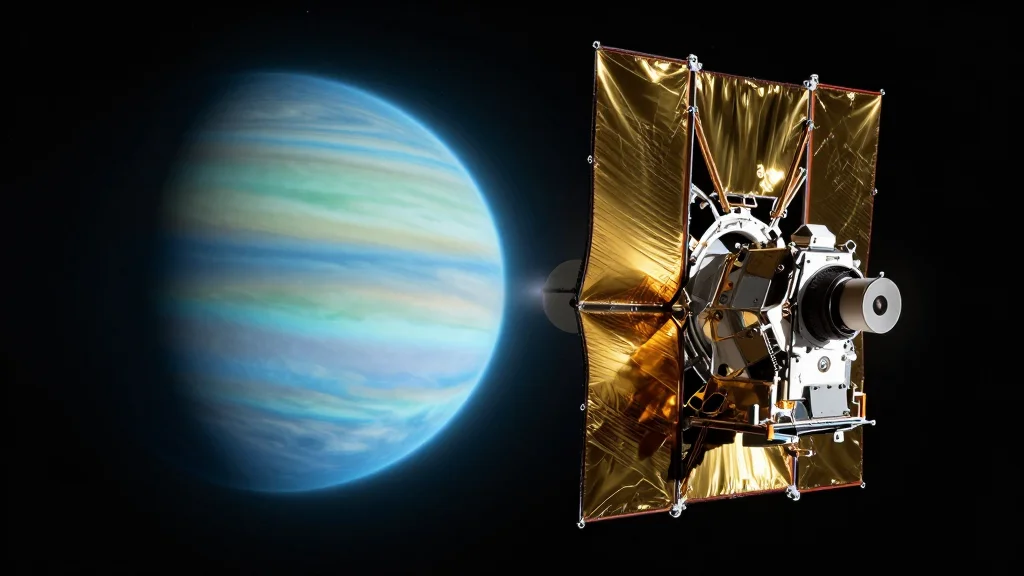
JWST Images 29 Cygni B, Redefining Planet‑Star Boundary

Why It Matters
The ability to pinpoint how the most massive planets form reshapes fundamental theories of planetary system evolution. By demonstrating that accretion can produce bodies up to at least 15 Jupiter masses, the study challenges the conventional mass ceiling that separates planets from brown dwarfs, prompting a shift toward formation‑based taxonomy. This reclassification will influence the design of future exoplanet surveys, the interpretation of atmospheric spectra, and the allocation of telescope time across competing scientific goals. Beyond taxonomy, the discovery informs models of disk chemistry and dynamics. Heavy elements such as carbon and oxygen, observed in 29 Cygni b’s atmosphere, provide clues about the composition of the natal disk and the efficiency of material mixing. Understanding these processes is essential for predicting the habitability potential of smaller, rocky worlds that share the same birth environment.
Key Takeaways
- •JWST directly imaged 29 Cygni b, a 15‑Jupiter‑mass companion.
- •Spectra reveal carbon and oxygen signatures consistent with accretion.
- •Balmer’s team used NIRCam coronagraphic mode to capture near‑infrared data.
- •Object orbits at 1.5 billion miles, similar to Uranus’s distance from the Sun.
- •Findings suggest the planet‑star mass boundary may need revision.
Pulse Analysis
The JWST result arrives at a pivotal moment for exoplanet science, where the community is transitioning from discovery to characterization. Historically, the 13‑Jupiter‑mass deuterium‑burning limit served as a convenient, albeit arbitrary, divider between planets and brown dwarfs. This new evidence shows that the formation mechanism, not just mass, can produce objects well beyond that threshold, echoing earlier theoretical work that predicted a continuum of outcomes in massive disks. By anchoring the debate in observational chemistry, the study provides a concrete metric that can be applied across future surveys.
From a strategic perspective, the discovery underscores the value of JWST’s high‑contrast imaging capabilities. The ability to isolate faint planetary signals near bright stars opens a pathway to systematically map the atmospheric composition of a wide mass range, something that was out of reach for previous observatories. As the telescope continues to deliver such high‑fidelity data, funding agencies and mission planners are likely to prioritize programs that exploit this niche, potentially accelerating the development of next‑generation coronagraphs and starshades.
Looking forward, the redefinition of the planet‑star boundary could ripple through related fields, from stellar evolution to astrobiology. If massive planets are more common than previously thought, the frequency of stable, habitable zones around Sun‑like stars may need to be recalculated, influencing target selection for missions like the Habitable Exoplanet Observatory. Moreover, the chemical fingerprints identified here could become a benchmark for testing planet formation models, driving a new era of theory‑driven observation.
JWST Images 29 Cygni b, Redefining Planet‑Star Boundary
Comments
Want to join the conversation?
Loading comments...