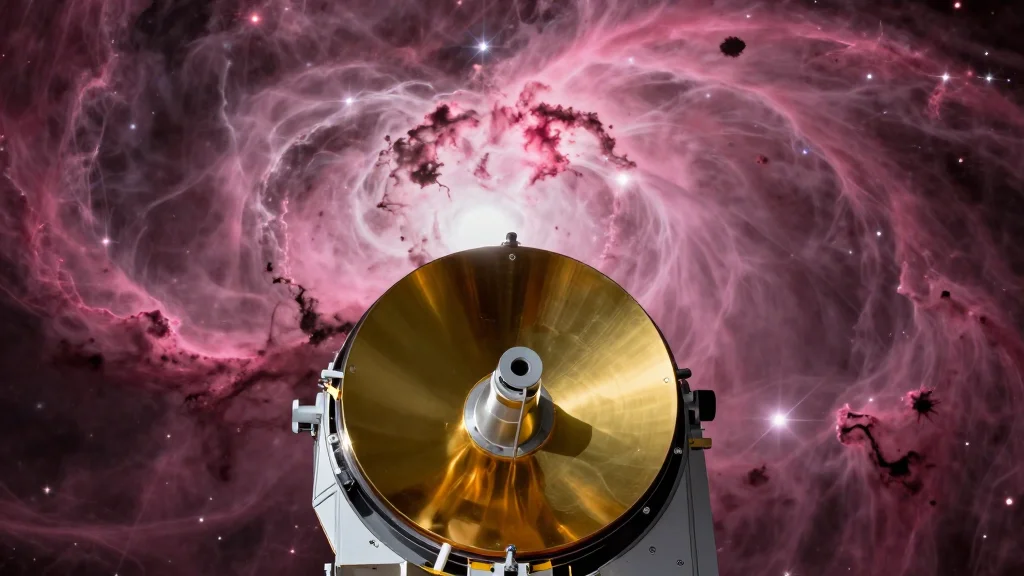
JWST Infrared Imaging Maps 10,000 Solar Masss in W51A Star Nursery

Why It Matters
Understanding how massive stars form is central to astrophysics because these stars dominate the energy budget of galaxies, drive chemical enrichment, and influence the dynamics of the interstellar medium. The JWST observations of W51A provide a rare, detailed snapshot of the earliest stages of massive cluster formation, offering empirical constraints that have been missing from theoretical models. By revealing both feedback‑driven bubbles and ongoing accretion streams within the same region, the study forces a reevaluation of how quickly and efficiently massive stars can alter their birth environments. This knowledge will improve predictions of star formation rates in both the Milky Way and distant galaxies, where direct observations are far more limited.
Key Takeaways
- •JWST NIRCam and MIRI captured high‑resolution infrared images of W51A.
- •Two protoclusters, W51‑IRS2 and W51‑E, each sculpt ~10,000 solar masses of gas.
- •W51‑IRS2 has created a bubble via stellar feedback; W51‑E is still fed by dust filaments.
- •Findings challenge uniform collapse models of massive star formation.
- •Future JWST spectroscopic work will probe gas dynamics and chemical composition.
Pulse Analysis
The W51A observations mark a watershed for empirical studies of massive star formation, moving the field from indirect inference to direct imaging of the physical processes at play. Historically, astronomers relied on radio and sub‑millimeter data that could trace dense gas but lacked the spatial resolution to resolve individual feedback structures. JWST’s infrared vision bridges that gap, delivering sub‑arcsecond detail that reveals how massive protostars simultaneously erode and accrete material.
From a competitive standpoint, the study showcases the United States’ leadership in leveraging JWST for galactic science, a narrative that will influence funding decisions for next‑generation infrared observatories. European and Asian teams are already planning complementary observations with the upcoming Extremely Large Telescope (ELT) and the Chinese Space Infrared Telescope for Cosmology and Astrophysics (CSST). The synergy between JWST’s imaging and ground‑based spectroscopy will likely become the standard approach for dissecting star‑forming regions.
Looking ahead, the data from W51A will serve as a calibration point for machine‑learning models that aim to predict star formation outcomes from cloud properties. As more JWST programs target similar regions, the community will amass a statistically robust sample, enabling a transition from case studies to population‑level insights. This shift could ultimately refine galaxy‑scale simulations, improving our understanding of how star formation regulates galaxy evolution across cosmic time.
JWST Infrared Imaging Maps 10,000 Solar Masss in W51A Star Nursery
Comments
Want to join the conversation?
Loading comments...