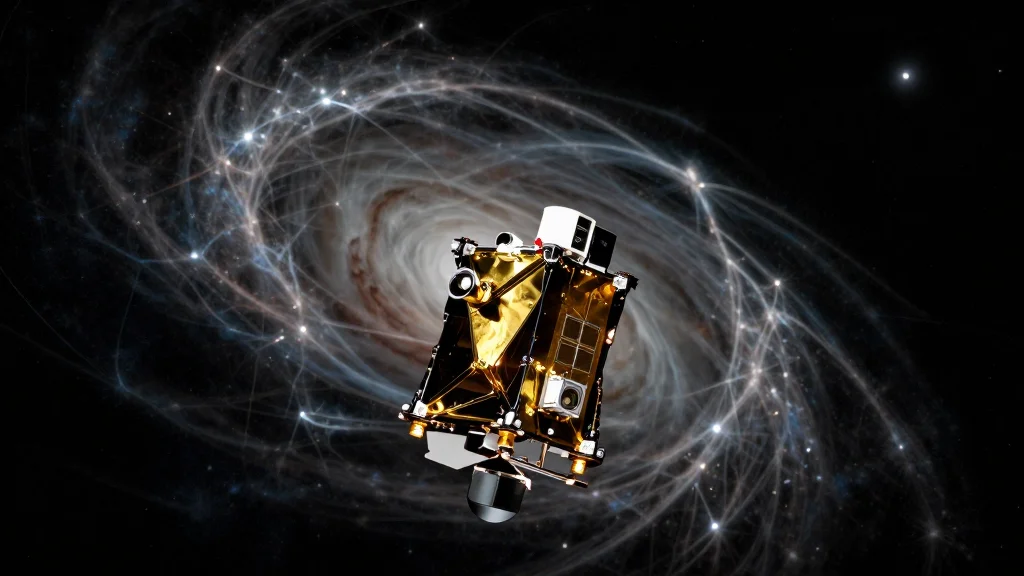
JWST Maps Cosmic Web in Unprecedented Detail, Reaching Back 1 Billion Years

Why It Matters
The JWST‑generated cosmic‑web map transforms a theoretical construct into an observable reality, enabling direct tests of the prevailing cosmological model. By pinpointing the distribution of dark matter and the pathways of gas inflow, the map informs how galaxies acquire mass and evolve, addressing long‑standing questions about star‑formation histories and the role of environment in shaping galaxy properties. Moreover, the unprecedented depth of the data opens a new window onto the early universe, where deviations from standard models could hint at new physics. Beyond pure science, the visualization underscores JWST’s capability to deliver transformative insights across astronomy, justifying continued investment in space‑based infrared observatories. The map also serves as a powerful outreach tool, illustrating the universe’s grand design to the public and inspiring the next generation of cosmologists.
Key Takeaways
- •JWST’s COSMOS‑Web survey mapped over 164,000 galaxies across a sky area the size of three full Moons.
- •The new cosmic‑web reconstruction reaches back to when the universe was ~1 billion years old.
- •Bright filaments and dark voids are resolved with unprecedented depth, surpassing Hubble’s earlier maps.
- •Findings published in The Astrophysical Journal provide a new benchmark for ΛCDM simulations.
- •Future JWST and Roman Telescope observations will extend the map to even earlier cosmic epochs.
Pulse Analysis
The release of JWST’s most detailed cosmic‑web map marks a watershed for observational cosmology, converting a largely statistical framework into a high‑resolution atlas. Historically, the cosmic web was inferred from galaxy redshift surveys and N‑body simulations, with only indirect evidence of its filamentary nature. JWST’s infrared sensitivity now captures the faint, high‑redshift galaxies that trace the web’s backbone, delivering a dataset that can validate or falsify the fine‑grained predictions of ΛCDM and its alternatives.
From a competitive standpoint, the achievement reinforces JWST’s dominance over ground‑based facilities for deep‑field imaging, despite the upcoming launch of the Roman Space Telescope, which will excel in wide‑area surveys but lack JWST’s resolution. The synergy between the two missions could soon produce a multi‑scale view: Roman mapping the web’s large‑scale topology, while JWST fills in the high‑resolution details of individual filaments. This collaborative model may become the standard for probing dark‑matter distribution and galaxy evolution.
Looking ahead, the map’s granularity will likely drive a new generation of theoretical work, prompting refinements in hydrodynamic simulations that must now reproduce the observed filament thickness, galaxy bias, and void emptiness at early times. As the community digests these results, we can expect a surge in proposals targeting the same regions with spectroscopic follow‑ups, aiming to measure gas kinematics and metallicities within the filaments. Such data will close the loop between structure formation and baryonic physics, ultimately sharpening our picture of how the universe’s scaffolding gave rise to the rich tapestry of galaxies we see today.
JWST Maps Cosmic Web in Unprecedented Detail, Reaching Back 1 Billion Years
Comments
Want to join the conversation?
Loading comments...