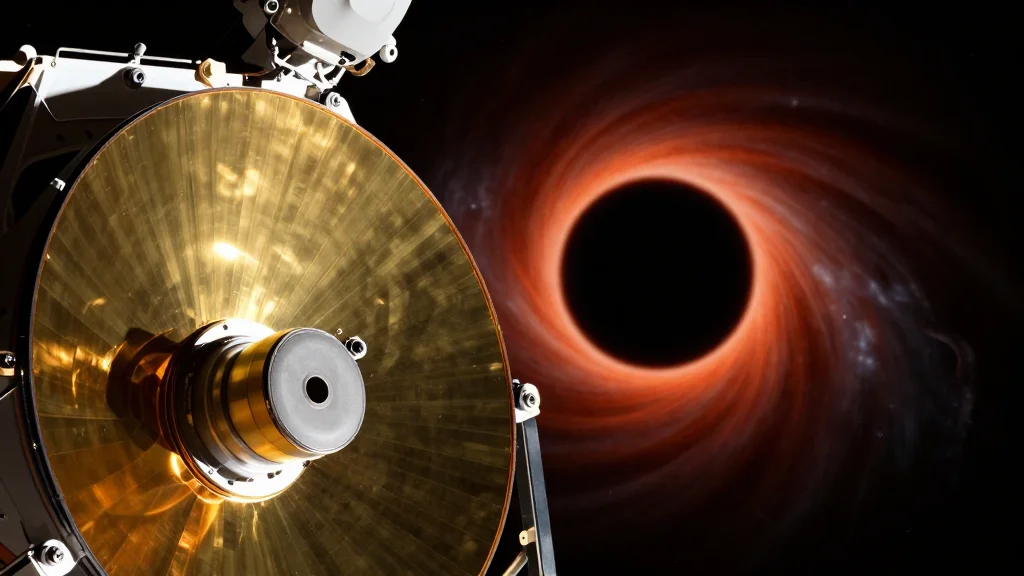
JWST Measures Mass of a Dormant Black Hole From the Early Universe for the First Time
Why It Matters
Measuring a non‑active black hole at such an early epoch tests theories of rapid black‑hole seed formation and informs models of galaxy evolution in the young universe.
Key Takeaways
- •JWST measured mass of dormant black hole at redshift ~7.
- •Mass estimated at ~1.5 × 10⁸ solar masses.
- •Used NIRSpec spectroscopy of surrounding star cluster dynamics.
- •First direct mass measurement of non‑active black hole beyond 12 billion light‑years.
- •Challenges existing models of early black‑hole growth rates.
Pulse Analysis
The James Webb Space Telescope’s ability to capture faint infrared signatures has opened a new window on the universe’s dark corners. By targeting a faint galaxy at redshift 7, astronomers leveraged NIRSpec’s high‑resolution spectroscopy to map the velocities of stars orbiting an unseen mass. The resulting dynamical analysis yielded a black‑hole mass of roughly 150 million suns, a figure that rivals the most massive quasars known from the same epoch but without the blinding glare of active accretion. This breakthrough demonstrates that JWST can probe the gravitational influence of dormant black holes, a capability previously limited to nearby galaxies observed with ground‑based telescopes.
The discovery carries profound implications for black‑hole formation theories. Traditional models struggle to explain how seed black holes, born from the collapse of massive stars, could amass hundreds of millions of solar masses within a few hundred million years. The measured mass of a quiet black hole suggests that rapid, possibly super‑Eddington, growth phases may have been more common than thought, or that massive seeds formed directly from dense gas clouds. Either scenario forces a reevaluation of the balance between accretion, mergers, and feedback processes that shape early galaxy evolution.
Beyond theoretical impact, the measurement showcases a new observational pathway for cosmology. Future JWST programs can replicate this technique across a broader sample of high‑redshift galaxies, building a statistical picture of dormant black‑hole demographics. Such data will refine estimates of the total black‑hole mass density in the early universe and help calibrate simulations that link black‑hole growth to the assembly of the first massive galaxies. As JWST continues its mission, the ability to weigh invisible giants promises to illuminate the hidden scaffolding of cosmic structure.
JWST Measures Mass of a Dormant Black Hole from the Early Universe for the First Time
Comments
Want to join the conversation?
Loading comments...