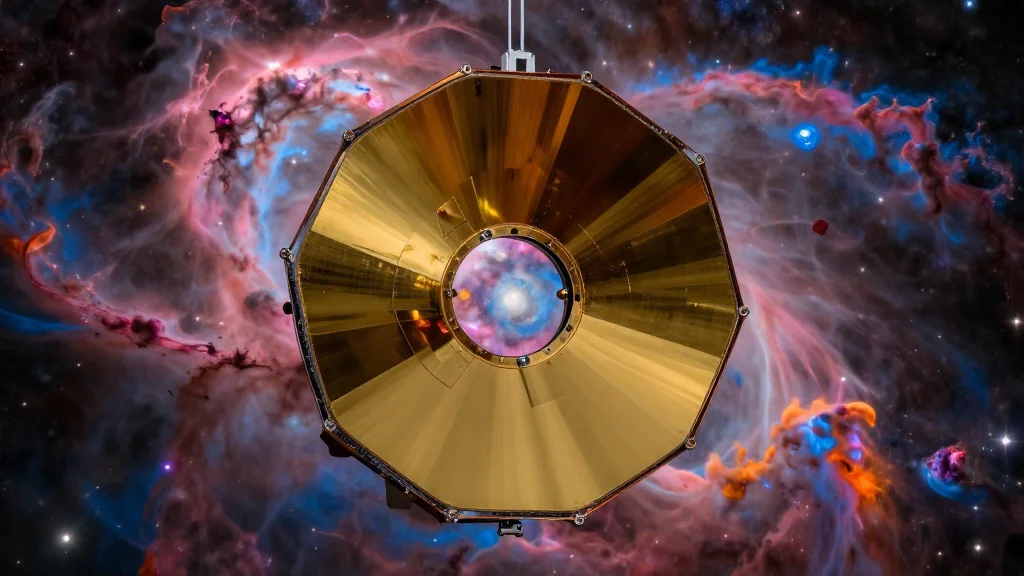
JWST Uncovers the Lobster Nebula’s Firestorm of Starbirth
Companies Mentioned

Why It Matters
Understanding how massive stars and their winds sculpt their birth clouds informs models of star formation and chemical enrichment across the Milky Way, impacting predictions for future stellar populations.
Key Takeaways
- •JWST reveals thousands of hidden stars in Pismis 24 cluster.
- •Brightest star Pismis 24‑1 is a binary of 74 and 66 M☉.
- •Stellar winds carve cavities, suppressing protoplanetary disks nearby.
- •Infrared imaging shows ionized hydrogen blue and dust orange in nebula.
- •Lobster Nebula spans ~300 light‑years, 5,500 ly from Earth.
Pulse Analysis
The James Webb Space Telescope’s infrared capabilities have opened a new window onto the Milky Way’s most active star‑forming regions. By piercing the dense dust that obscures visible light, JWST uncovered a dense population of young, massive stars in the Pismis 24 cluster, a key laboratory for studying the early lives of O‑type stars. The detailed view not only adds thousands of previously unseen members to the cluster’s census but also maps the distribution of ionized hydrogen and warm dust, offering a three‑dimensional picture of how radiation and stellar winds interact with their natal clouds.
At the core of the nebula, the brightest source—once thought to be a single monster—has been resolved as a binary pair weighing 74 and 66 solar masses. These behemoths radiate intense ultraviolet light, generating powerful stellar winds that excavate cavities and sculpt towering spires reminiscent of the Eagle Nebula’s Pillars of Creation. The winds also appear to suppress the formation of protoplanetary disks in the immediate vicinity, suggesting that massive clusters may inhibit planet formation around nearby low‑mass stars. This dynamic environment provides a real‑time case study of feedback mechanisms that regulate star formation efficiency in giant molecular clouds.
For astronomers, the Lobster Nebula serves as a nearby analog for the massive star‑forming complexes that shape galactic evolution. The insights gained from JWST’s observations will refine theoretical models of stellar feedback, chemical enrichment, and the lifecycle of interstellar matter. As JWST continues to survey similar regions, the data will help predict how the Milky Way’s stellar population will evolve over the next billions of years, informing both astrophysical research and the broader narrative of our cosmic origins.
JWST uncovers the Lobster Nebula’s firestorm of starbirth
Comments
Want to join the conversation?
Loading comments...