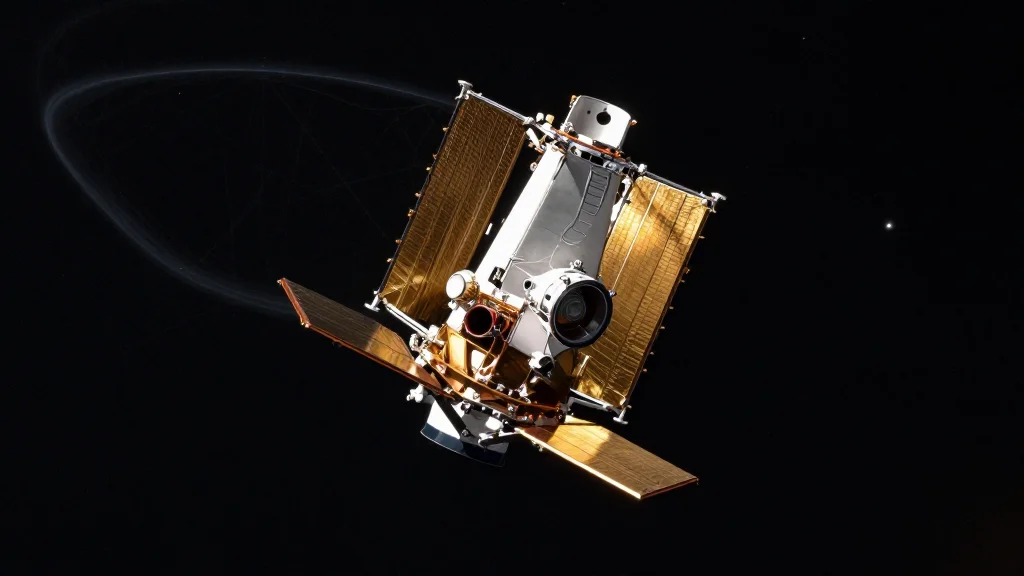
JWST Unveils Most Detailed 14‑Billion‑Year Cosmic Web Map

Why It Matters
The COSMOS‑Web map translates abstract cosmological theory into a concrete visual framework, allowing scientists to test predictions about dark matter distribution and dark energy’s influence on cosmic expansion. By resolving structures that were previously blurred, the map sharpens our understanding of how galaxies form and evolve within their large‑scale environment, a key piece in the puzzle of the universe’s history. Moreover, the public release of this dataset will democratize access to cutting‑edge observations, fostering collaboration across institutions and accelerating discoveries in fields ranging from galaxy evolution to fundamental physics. The map’s depth and breadth also set a new standard for future space‑based surveys, informing the design of next‑generation telescopes and guiding investment in complementary ground‑based facilities.
Key Takeaways
- •JWST’s COSMOS‑Web survey produced the most detailed cosmic‑web map, spanning 13.7 billion years of history.
- •The map covers a sky area equal to three full Moons, the largest continuous JWST field to date.
- •Lead author Hossein Hatamnia highlighted JWST’s ability to provide a wide, deep view of the web.
- •The dataset resolves filaments and voids previously blended in Hubble images, tightening cosmological constraints.
- •Full data release slated for later 2026, enabling cross‑analysis with Euclid and Rubin Observatory surveys.
Pulse Analysis
JWST’s COSMOS‑Web map arrives at a moment when the astrophysics community is hungry for high‑resolution, large‑scale structure data to confront tensions in the standard cosmological model. Recent discrepancies in the Hubble constant and the amplitude of matter fluctuations (σ8) have spurred calls for independent probes of dark matter clustering. By delivering a three‑dimensional map that directly traces the distribution of galaxies within the dark‑matter web, JWST provides a new lever to measure σ8 and test whether the observed growth of structure aligns with predictions from the ΛCDM framework.
Historically, cosmic‑web studies relied on sparse spectroscopic surveys and the relatively shallow imaging of Hubble. JWST’s infrared capability penetrates dust and reaches fainter, higher‑redshift galaxies, effectively extending the observable web into the epoch of reionization. This leap not only refines our picture of early galaxy assembly but also offers a statistical baseline for upcoming missions. Euclid’s wide‑field optical/near‑infrared survey will map billions of galaxies over a larger area, while Rubin’s time‑domain observations will capture transient phenomena within the web. COSMOS‑Web’s depth will serve as a calibration set, ensuring that the broader, shallower surveys are anchored to a robust, high‑fidelity reference.
Looking ahead, the map’s public release will likely spark a wave of theoretical work aimed at reconciling small‑scale anomalies—such as the “missing satellites” problem—with the newly resolved filamentary network. If subsequent analyses reveal systematic deviations from ΛCDM predictions, the community may be forced to consider alternative dark‑matter candidates or modifications to gravity. In any case, JWST’s achievement demonstrates that space‑based infrared astronomy can move beyond point‑source discoveries to chart the universe’s grand architecture, setting a precedent for the next generation of cosmological observatories.
JWST Unveils Most Detailed 14‑Billion‑Year Cosmic Web Map
Comments
Want to join the conversation?
Loading comments...