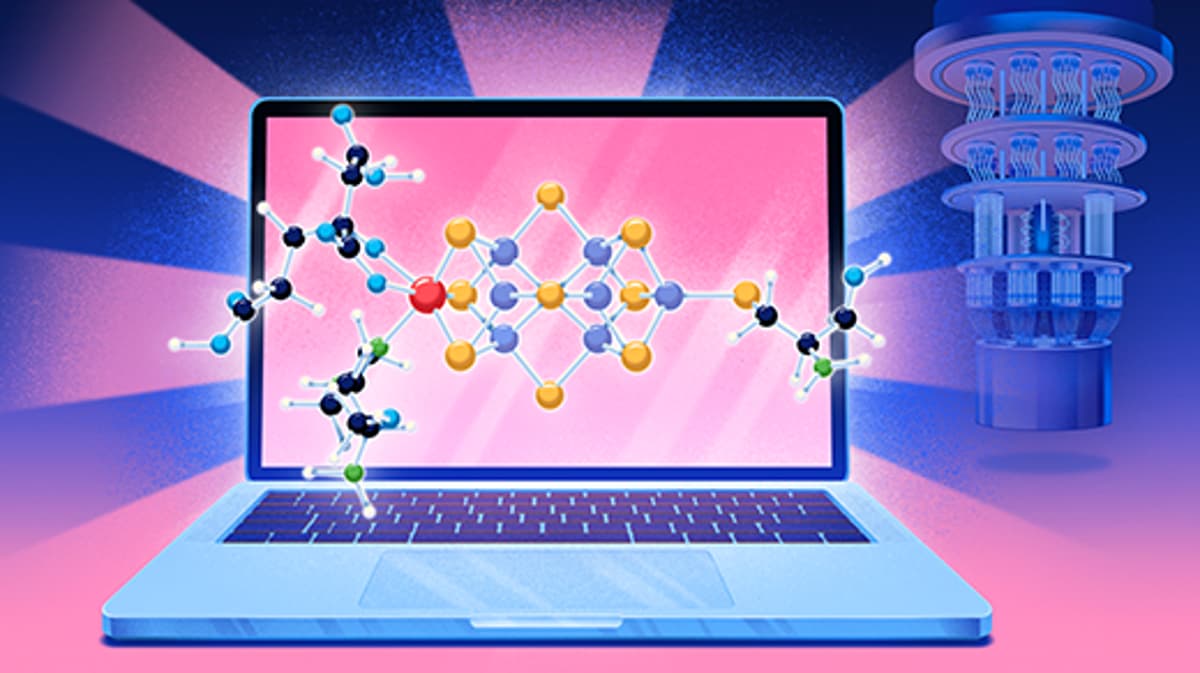
Key Chemistry Question Answered, No Quantum Computer Required
Companies Mentioned
Why It Matters
It shows that classical supercomputing can still solve landmark quantum chemistry problems, tempering expectations for immediate quantum‑computing breakthroughs and influencing funding and research strategies in both fields.
Key Takeaways
- •Classical algorithms determined nitrogenase FeMo‑co ground‑state energy.
- •Result suggests quantum computers not required for this chemistry problem yet.
- •Techniques used: incremental electron adjustment and limited information flow.
- •Debate persists on quantum advantage for dynamic chemical simulations.
- •Success may speed classical modeling of other complex enzymes.
Pulse Analysis
Nitrogenase, the enzyme that converts atmospheric nitrogen into bioavailable ammonia, has been a poster child for quantum‑computing hype because its FeMo‑co cluster hosts thousands of entangled electron configurations. Researchers have long argued that only a fault‑tolerant quantum processor could capture the full quantum many‑body wavefunction, positioning the molecule as a litmus test for the next generation of hardware. Chan’s team, however, leveraged decades‑old advances in tensor‑network compression and clever configuration pruning to isolate the most energetically relevant electron arrangements, delivering a ground‑state energy that aligns with laboratory measurements. This accomplishment underscores that algorithmic ingenuity on classical supercomputers can still push the frontier of chemical accuracy.
The methodological core of the breakthrough rests on two complementary strategies. First, incremental electron adjustment systematically expands the active space, revealing that beyond a modest subset of electrons, additional excitations contribute negligibly to the total energy. Second, limiting information flow between partitioned subsystems curtails the combinatorial explosion of entanglement, allowing the calculation to remain tractable on existing hardware. Together, these tactics compress the problem’s dimensionality without sacrificing fidelity, offering a template that could be adapted to other metalloenzymes and catalytic complexes where electron correlation dominates. For the quantum‑computing community, the work reframes the benchmark: rather than a binary win‑lose test, nitrogenase now serves as a nuanced case study of where classical and quantum methods intersect.
Looking ahead, the result is unlikely to halt quantum‑hardware development, but it does recalibrate expectations. Industries investing in quantum chemistry—pharma, materials, and energy—may adopt a hybrid roadmap, deploying classical high‑performance computing for static properties while reserving quantum resources for dynamic simulations where time‑evolution and non‑adiabatic effects become prohibitive for classical approaches. Moreover, the public validation of classical techniques could attract additional funding toward algorithmic research, accelerating the pace at which other biologically critical enzymes become computationally tractable. In a landscape where both classical supercomputers and quantum processors are advancing, Chan’s achievement illustrates that progress need not be an either‑or proposition; instead, the two paradigms can complement each other to unlock deeper chemical insight.
Key Chemistry Question Answered, No Quantum Computer Required
Comments
Want to join the conversation?
Loading comments...