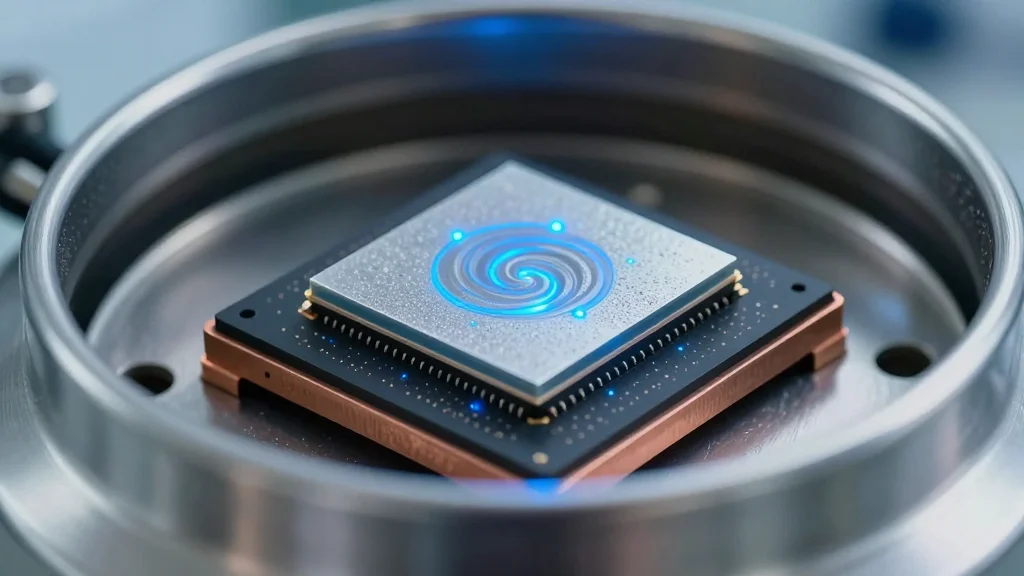
KIT Researchers Turn Superconducting Vortices Into Controllable Qubits

Why It Matters
By converting a long‑standing source of loss into a functional quantum element, the discovery expands the toolbox of quantum engineers and could accelerate the scaling of quantum processors. It also underscores the importance of materials science in quantum technology, suggesting that other ‘defects’—from two‑level systems to phonon modes—might be similarly harnessed. If vortex qubits can be reliably manufactured, they may enable quantum computers that operate under higher magnetic fields, opening new application domains such as quantum sensing in harsh environments. Beyond hardware, the work challenges the prevailing narrative that disorder is inherently detrimental to quantum coherence. It invites a re‑examination of other disordered or amorphous systems, potentially spurring a wave of research into unconventional qubit platforms that blend condensed‑matter physics with quantum information science.
Key Takeaways
- •KIT scientists demonstrate magnetic vortices as controllable qubits with microsecond coherence.
- •Experiments used granular‑aluminum thin films near the superconductor‑to‑insulator transition.
- •Coherence times comparable to leading transmon qubits, per microwave spectroscopy measurements.
- •Study published in Nature, highlighting a shift from defect mitigation to defect exploitation.
- •Future work will target multi‑vortex coupling and integration into scalable quantum circuits.
Pulse Analysis
The vortex‑qubit breakthrough arrives at a moment when the quantum hardware race is diversifying beyond the traditional transmon paradigm. Historically, superconducting qubits have relied on clean, low‑disorder materials to minimize decoherence. KIT’s approach flips that script, leveraging disorder to create a protected two‑level system. This could lower barriers to entry for labs that lack ultra‑pure fabrication facilities, democratizing access to high‑coherence qubits.
From a market perspective, the discovery may prompt chip manufacturers to revisit material stacks that were previously dismissed as too noisy. Companies such as IBM, Google, and Rigetti have invested heavily in planar aluminum processes; integrating granular aluminum could be a modest process tweak rather than a wholesale redesign. Moreover, the magnetic‑field tolerance of vortex qubits could complement emerging quantum‑sensor applications that require operation in non‑zero field environments, a niche where conventional qubits falter.
Looking ahead, the critical test will be scalability. While single‑vortex control is a proof of concept, quantum error correction demands thousands of reliably coupled qubits. The disorder‑driven nature of the platform may introduce variability that complicates uniform gate operations. Nonetheless, the ability to engineer the disorder—through deposition parameters, annealing, and substrate choice—offers a lever that could be refined with industry‑scale process control. If successful, vortex qubits could become a third pillar in the quantum hardware ecosystem, alongside transmons and spin‑based qubits, enriching the design space for future quantum computers.
KIT Researchers Turn Superconducting Vortices into Controllable Qubits
Comments
Want to join the conversation?
Loading comments...