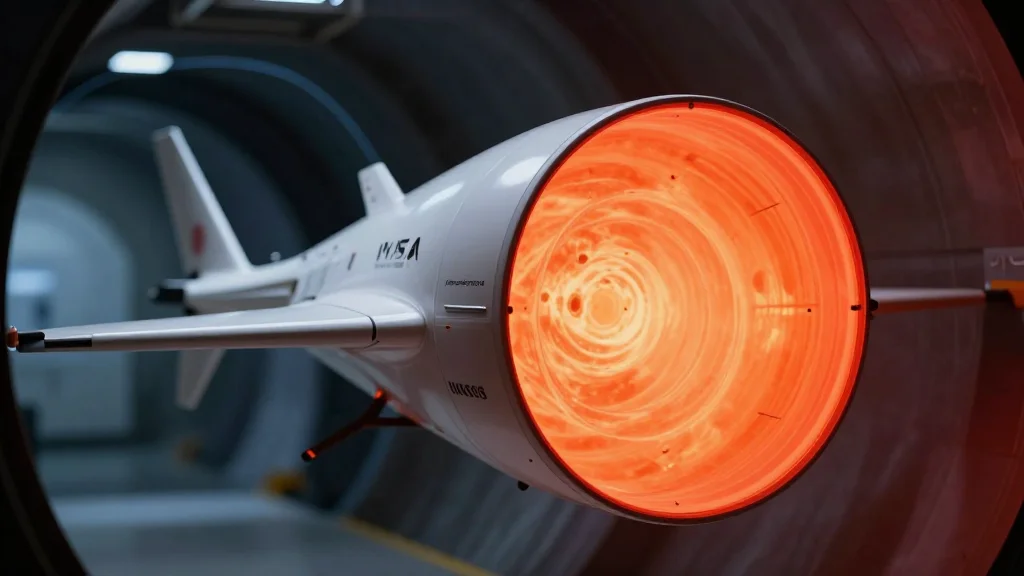
Lab Recreates Flight-Like Heat to Support NASA’s Dragonfly Mission to Titan
Why It Matters
Demonstrating TPS performance under Titan‑like heat ensures Dragonfly can survive entry, safeguarding a multi‑billion‑dollar investment and advancing U.S. planetary exploration capabilities.
Key Takeaways
- •Sandia’s plasma wind tunnel reproduced Titan entry heat fluxes.
- •Test achieved temperatures up to 1,200 °C, matching mission predictions.
- •Thermal protection system performance validated for Dragonfly’s rotorcraft.
- •Data will refine entry‑trajectory models and safety margins.
- •Collaboration strengthens U.S. leadership in outer‑planet exploration.
Pulse Analysis
Titan, Saturn’s largest moon, presents a uniquely harsh environment for spacecraft: a thick nitrogen‑rich atmosphere, surface pressures 1.5 times Earth’s, and a frigid 94 K temperature. When a vehicle pierces this envelope at high speed, it experiences intense aerodynamic heating that can exceed a thousand degrees Celsius. Sandia’s state‑of‑the‑art plasma wind tunnel replicates these conditions by generating a high‑energy plasma flow, allowing engineers to expose Dragonfly’s thermal protection panels to realistic heat fluxes and measure their response in real time. This capability bridges the gap between computer simulations and real‑world performance, delivering data that is essential for certifying the spacecraft’s safety.
The recent test campaign focused on the Dragonfly rotorcraft’s heat shield, a composite TPS designed to ablate and dissipate energy during the brief but severe entry phase. By subjecting the shield to temperatures around 1,200 °C, the team confirmed that material erosion rates and structural integrity remain within design tolerances. The experiment also captured high‑resolution temperature gradients across the shield, feeding directly into refined entry‑trajectory models that optimize descent angles and fuel margins. Such empirical validation reduces reliance on conservative safety buffers, potentially shaving weight and cost from the final spacecraft.
Beyond the immediate mission, this achievement underscores the strategic value of domestic high‑enthalpy testing facilities. As NASA eyes more ambitious missions to icy worlds—Europa, Enceladus, and beyond—having a proven method to simulate alien atmospheric entry will accelerate technology readiness and lower program risk. Sandia’s collaboration with NASA not only safeguards the Dragonfly investment, estimated at several hundred million dollars, but also reinforces the United States’ leadership in deep‑space exploration, setting a benchmark for future planetary probes.
Lab Recreates Flight-Like Heat to Support NASA’s Dragonfly Mission to Titan
Comments
Want to join the conversation?
Loading comments...