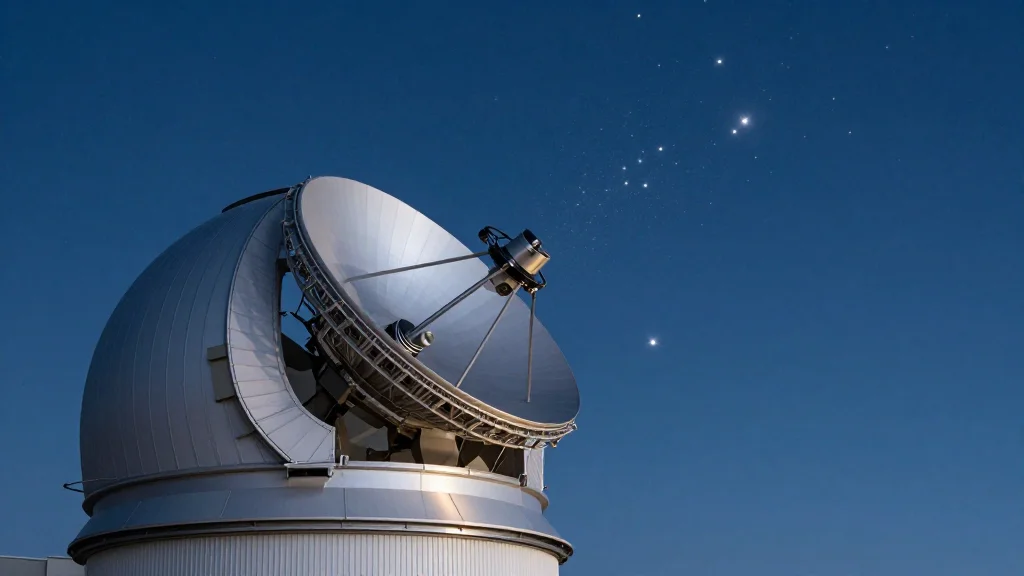
LAMOST Maps Open Cluster NGC 1647, Linking Broad Main Sequence to Differential Reddening
Why It Matters
Understanding the role of differential reddening clarifies why some clusters display extended main‑sequence turn‑offs, improving age‑dating techniques essential for galactic evolution studies. The large spectroscopic dataset also provides a benchmark for calibrating stellar models across a range of masses and rotation rates.
Key Takeaways
- •LAMOST analyzed 347 spectra, 158 unique stars in NGC 1647.
- •Radial velocity peak at –5.32 km/s with 1.57 km/s dispersion.
- •Average metallicity measured at –0.08 dex, near solar.
- •Differential reddening of 1.1 mag drives extended main‑sequence turn‑off.
- •Cluster age refined to ~203 million years.
Pulse Analysis
LAMOST’s high‑throughput spectroscopic capability is reshaping the study of nearby open clusters. By targeting NGC 1647, a relatively understudied group in Taurus, researchers assembled the most extensive spectral catalog for the cluster, enabling precise measurements of radial velocities, rotational speeds, and elemental abundances. The resulting velocity distribution, centered at –5.32 km s⁻¹, confirms the cluster’s kinematic coherence, while the modest metallicity offset (–0.08 dex) reinforces its status as a near‑solar composition population, a useful reference point for testing stellar evolution models.
The standout finding is the identification of a 1.1‑mag differential reddening gradient across the cluster field. This spatial variation in interstellar dust extinction correlates tightly with the color spread of stars near the lower main‑sequence boundary, suggesting that the broadened main‑sequence turn‑off—often interpreted as an age spread or rotational effect—is largely an observational artifact of uneven dust. Recognizing reddening as the primary driver refines age estimates, narrowing NGC 1647’s age to about 203 million years and reducing uncertainties that have long hampered cluster chronologies.
Beyond NGC 1647, the study exemplifies how combining LAMOST spectroscopy with Gaia’s astrometric precision can disentangle intrinsic stellar properties from line‑of‑sight effects. This synergy will be pivotal for upcoming large‑scale surveys aiming to map the Milky Way’s star‑forming history. As astronomers expand such analyses to more clusters, they will improve calibrations of stellar isochrones, enhance models of Galactic chemical evolution, and ultimately sharpen the timeline of our galaxy’s formation.
LAMOST maps open cluster NGC 1647, linking broad main sequence to differential reddening
Comments
Want to join the conversation?
Loading comments...