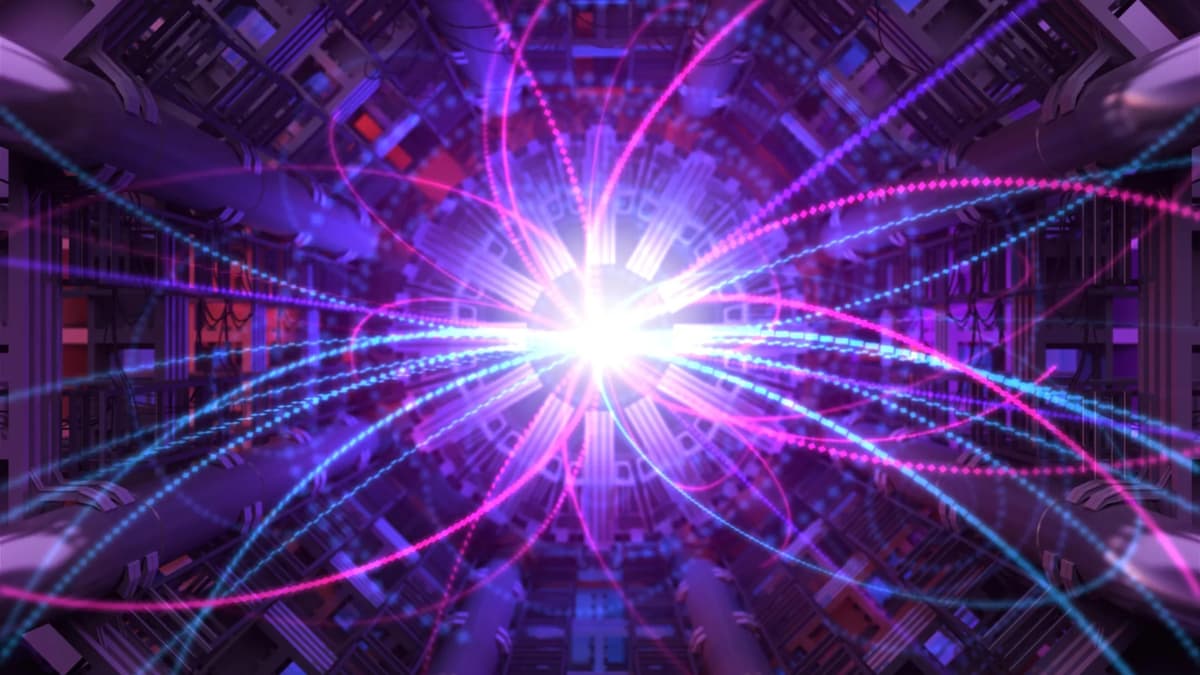
Large Hadron Collider Detects Strange Particle Behavior that Could Rewrite Physics
Why It Matters
A confirmed breach of the Standard Model would reshape the theoretical foundation of particle physics and guide the search for new particles such as leptoquarks, influencing future collider designs and funding priorities.
Key Takeaways
- •LHCb finds 4‑sigma tension in B‑meson penguin decay
- •Result matches earlier CMS observations, hinting at new physics
- •Anomaly could signal leptoquarks or heavy analogues beyond Standard Model
- •Upcoming LHC upgrades will increase data 15‑fold for confirmation
- •Rare decay occurs once per million B mesons, making measurement challenging
Pulse Analysis
The Standard Model has been the cornerstone of particle physics for five decades, yet it leaves gravity and dark matter unexplained. CERN’s Large Hadron Collider, the world’s most powerful accelerator, was built to probe the model’s limits by smashing protons at near‑light speed. One of its dedicated detectors, LHCb, focuses on the behavior of heavy‑flavor particles such as B mesons, whose rare decay channels act as sensitive microscopes for hidden forces. By scrutinizing these decays, physicists can detect subtle deviations that hint at new phenomena.
The latest LHCb analysis of an electroweak “penguin” decay shows a four‑sigma discrepancy with Standard Model expectations, meaning there is only a one‑in‑16,000 chance the result is a statistical fluke. The same decay pattern was observed, albeit with larger uncertainties, by the CMS experiment earlier this year, providing an independent cross‑check. Such a persistent tension points toward contributions from heavy, as‑yet‑undetected particles—candidates include leptoquarks that bridge quarks and leptons or heavier analogues of known bosons. If confirmed, these findings would force theorists to extend the model’s particle roster.
The LHCb collaboration examined roughly 650 billion B‑meson decays recorded between 2011 and 2018, and the accelerator has since amassed three times more data, with the upcoming High‑Luminosity upgrade slated to increase the dataset by another factor of fifteen. This avalanche of statistics will shrink experimental uncertainties and allow physicists to disentangle genuine new‑physics signals from the so‑called “charming penguin” background that mimics the effect. A definitive breakthrough would not only reshape textbooks but also steer the next generation of colliders, funding allocations, and interdisciplinary research that links particle physics to cosmology.
Large Hadron Collider detects strange particle behavior that could rewrite physics
Comments
Want to join the conversation?
Loading comments...