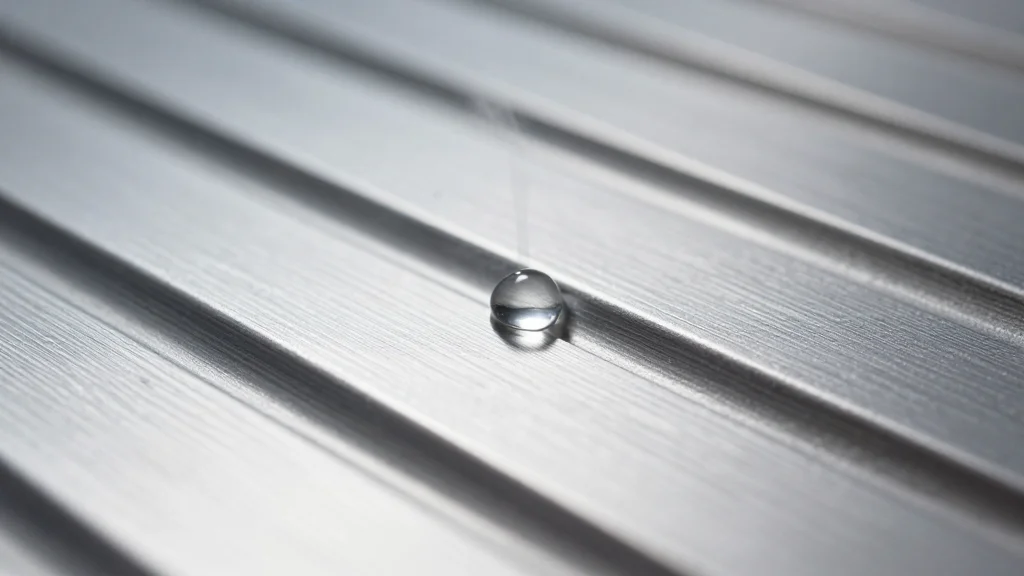
Laser Written Aluminum Surfaces Control Leidenfrost Droplet Motion
Key Takeaways
- •Femtosecond laser writes alternating smooth strips and asymmetric ripples on aluminum
- •Pattern creates hybrid boiling: film boiling on smooth, transition boiling on ripples
- •Droplets self‑propel along laser‑scan lines opposite to processing direction
- •Programmable trajectories enable targeted cooling, droplet trapping, and micro‑fluidic transport
- •Hybrid state balances droplet lifespan with enhanced heat transfer
Pulse Analysis
The Leidenfrost effect—where a liquid levitates on a vapor cushion above a superheated surface—has long fascinated physicists but remained difficult to harness in industry. Conventional approaches rely on uniformly patterned ratchets or pillars that bias droplet motion, yet they lock the droplet into a single boiling regime, either contact or film boiling. This trade‑off limits heat‑transfer efficiency and restricts the range of controllable trajectories, leaving a gap between fundamental insight and practical deployment in high‑heat environments such as metal forging or electronics cooling.
The breakthrough reported in Light: Advanced Manufacturing stems from a femtosecond laser that inscribes alternating smooth zones and asymmetric ripple‑like microstructures directly onto aluminum. The dual‑region surface creates a hybrid boiling state: film boiling persists over smooth strips while intermittent transition boiling occurs on the ripples, generating localized hot spots and asymmetric vapor jets. These jets produce an unbalanced Young’s force that pushes droplets along the laser‑scan lines, invariably opposite the writing direction. By simply re‑routing the laser path, engineers can dictate droplet routes, curvature, or even trap droplets, without altering the material or adding external fields.
Beyond the laboratory, this programmable droplet propulsion offers tangible value for sectors that juggle rapid heat removal with precise fluid placement. In high‑power electronics, directed Leidenfrost droplets could sweep heat away while maintaining a protective vapor layer, improving component lifespan. In additive manufacturing and welding, controlled droplet ejection may enable localized cooling or material delivery without contact contamination. The technique’s reliance on laser patterning—a process already integrated into many production lines—suggests a low‑barrier path to commercial adoption, positioning hybrid‑boiling surfaces as a next‑generation tool for thermal‑management and micro‑fluidic platforms.
Laser written aluminum surfaces control Leidenfrost droplet motion
Comments
Want to join the conversation?