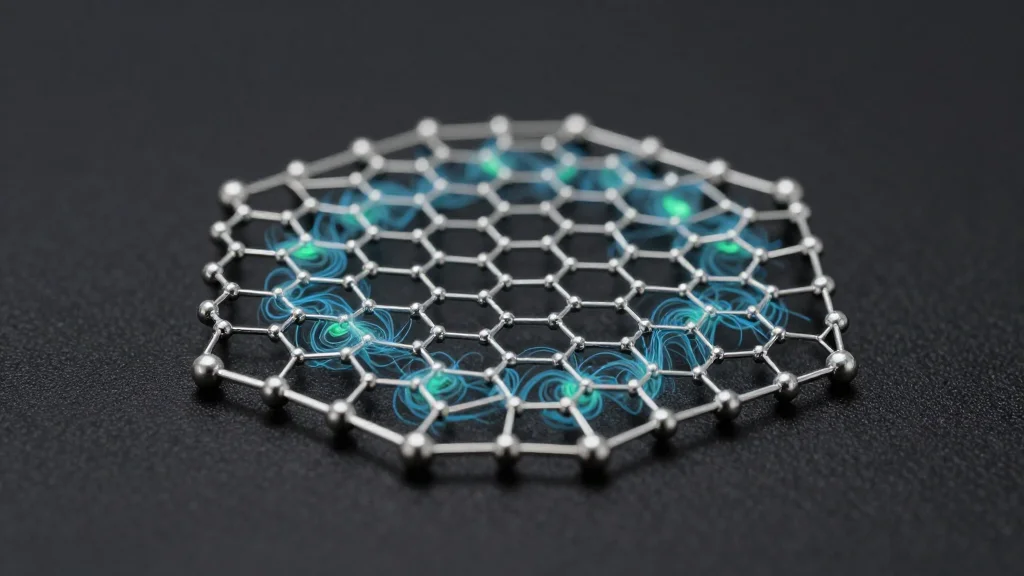
Lattice Symmetry Shapes Topological Spin Structures in Two-Dimensional Magnets
Key Takeaways
- •Cr₂Ge₂Te₆ spin textures follow crystal lattice symmetry.
- •Shapes range from triangles to octagons, not random.
- •Lattice, not Dzyaloshinskii–Moriya, stabilizes topological states.
- •Magnetic fields induce reversible splitting and merging of textures.
- •Findings enable lattice‑engineered routes for 2D spintronic devices.
Pulse Analysis
Topological spin structures such as skyrmions have become a cornerstone of next‑generation spintronic concepts because of their nanoscale size and robustness against perturbations. Historically, their formation in thin films and heterostructures has been attributed to the Dzyaloshinskii–Moriya interaction (DMI), an antisymmetric exchange that emerges at interfaces where crystal symmetries clash. In two‑dimensional van der Waals magnets, however, the role of intrinsic lattice symmetry has remained ambiguous, limiting the ability to predict or tailor magnetic textures solely through material stacking or external fields.
The new study from the High Magnetic Field Laboratory in Hefei resolves this ambiguity by directly imaging Cr₂Ge₂Te₆ single crystals with a custom high‑field magnetic force microscope. The researchers observed a striking correlation between the crystal’s hexagonal symmetry and the outlines of the spin textures, which manifested as regular triangles, squares, pentagons and octagons. Micromagnetic simulations and electron spin resonance data confirmed that local lattice distortions generate competing energy minima that pin the textures, effectively replacing DMI as the dominant stabilizing mechanism. Moreover, sweeping a magnetic field caused the textures to split, merge, or transition between distinct topological states, demonstrating a dual control knob: lattice geometry and field strength.
These insights have immediate implications for the design of ultra‑compact, low‑power memory and logic elements. By selecting or engineering lattice parameters—through strain, alloying or layer‑by‑layer assembly—engineers can pre‑define the topology of magnetic bits, while magnetic fields provide dynamic reconfiguration. The lattice‑driven paradigm also broadens the material palette beyond exotic heterostructures, allowing bulk‑like two‑dimensional crystals to serve as platforms for topological magnonics and quantum information processing. Future work will likely explore other van der Waals magnets, assess temperature stability, and integrate lattice‑engineered textures into device prototypes, accelerating the commercial rollout of spin‑based technologies.
Lattice symmetry shapes topological spin structures in two-dimensional magnets
Comments
Want to join the conversation?