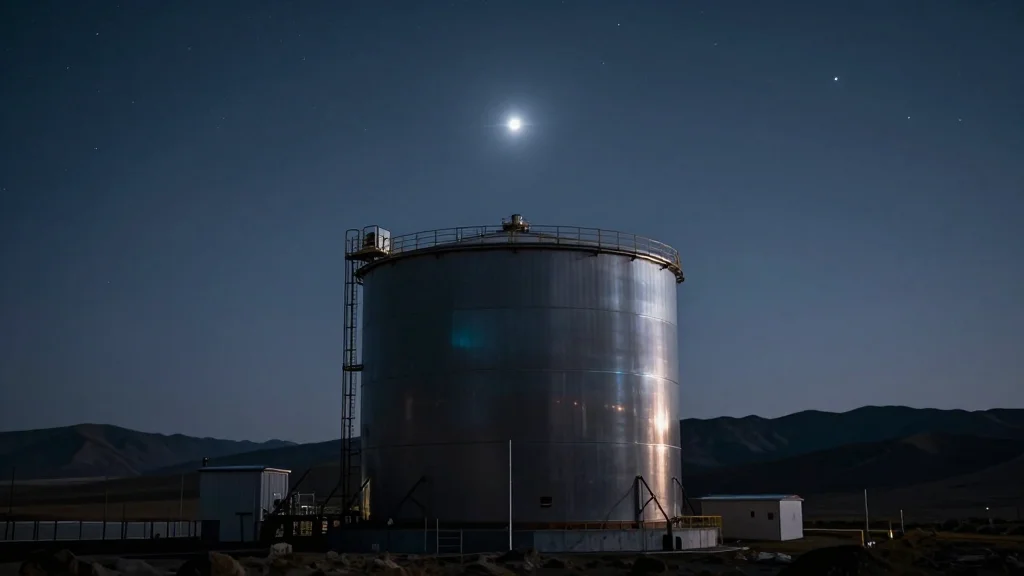
LHAASO Discovers "Aquila Booster," Challenging Theoretical Limits of Particle Acceleration in Pulsar Wind Nebulae
Why It Matters
By pushing the known energy ceiling for pulsar wind nebulae, the discovery reshapes theories of Galactic cosmic‑ray origins and informs future multi‑messenger astronomy strategies.
Key Takeaways
- •LHAASO detected gamma rays up to 1.4 PeV from Aquila Booster.
- •Acceleration exceeds standard pulsar wind nebula models by factor of two.
- •Findings suggest new mechanisms like magnetic reconnection may dominate.
- •Results reshape understanding of Galactic cosmic‑ray sources.
- •Observation opens path for multi‑messenger studies with neutrinos and X‑rays.
Pulse Analysis
The Aquila Booster discovery marks a watershed moment for high‑energy astrophysics. LHAASO’s extensive array of water‑Cherenkov detectors, positioned at 4,410 meters above sea level, captured a cascade of gamma‑ray events that point to particle energies surpassing one peta‑electronvolt. Such energies dwarf the typical few hundred tera‑electronvolt limits of pulsar wind nebulae, forcing scientists to revisit the magnetic field configurations and shock dynamics that power these cosmic accelerators.
Beyond theoretical intrigue, the breakthrough carries practical implications for the broader quest to pinpoint the sources of the Milky Way’s most energetic cosmic rays. If pulsar wind nebulae can indeed propel particles to PeV scales, they join supernova remnants as viable contributors to the so‑called “knee” in the cosmic‑ray spectrum. This re‑evaluation will likely steer upcoming observational campaigns, prompting coordinated observations across gamma‑ray, neutrino, and X‑ray facilities to capture the full multi‑messenger signature of such extreme environments.
The Aquila Booster also underscores the growing importance of next‑generation ground‑based observatories. As LHAASO continues to expand its sky coverage and sensitivity, its data will feed sophisticated models that blend plasma physics with relativistic magnetohydrodynamics. Stakeholders in space research, satellite design, and high‑energy particle instrumentation can expect a surge in funding and collaborative projects aimed at decoding these newly revealed acceleration mechanisms.
LHAASO Discovers "Aquila Booster," Challenging Theoretical Limits of Particle Acceleration in Pulsar Wind Nebulae
Comments
Want to join the conversation?
Loading comments...