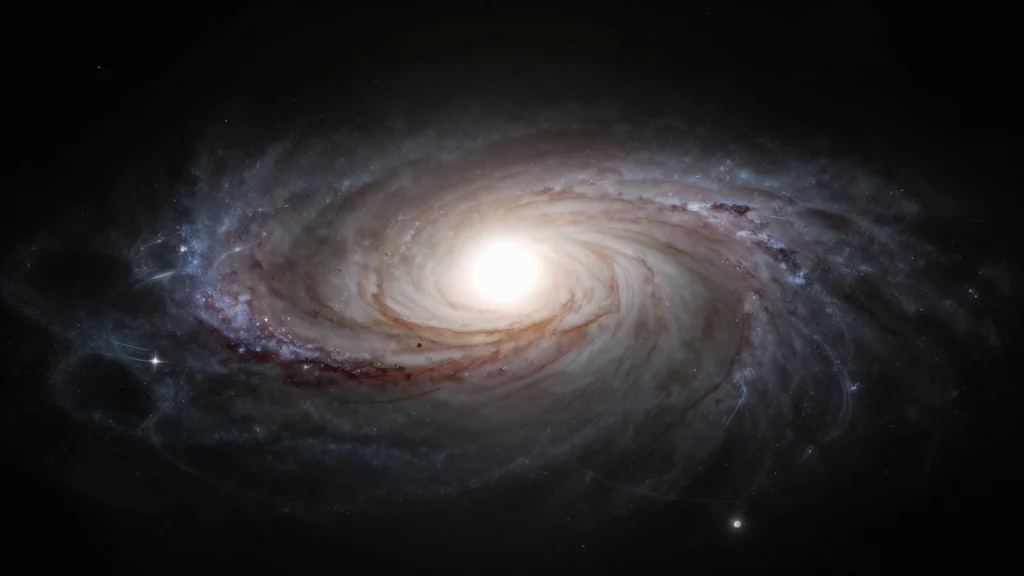
Light Echoes Reveal Possible Dark Matter Buildup Around Supermassive Black Holes
Why It Matters
The work introduces a novel, astronomy‑based method to probe dark matter near black holes, a regime previously inaccessible, potentially altering our understanding of galaxy evolution and cosmology.
Key Takeaways
- •Echo mapping applied to 14 AGN reveals excess mass in five galaxies
- •Dark matter predicted to form dense halos on black‑hole outskirts, non‑interacting
- •Method infers dark matter by comparing direct and echoed light signals
- •Findings remain preliminary; larger samples needed for statistical confidence
- •Confirmation would force revisions of black‑hole and cosmological simulations
Pulse Analysis
Dark matter remains one of the most elusive components of the cosmos, accounting for roughly 85% of all matter yet interacting only through gravity. While its large‑scale influence on galaxy rotation curves and cosmic structure is well documented, its behavior in the immediate vicinity of supermassive black holes has been largely theoretical. Traditional telescopes cannot directly image the invisible particles, leaving a gap in our understanding of how dark matter might shape accretion dynamics, jet formation, or black‑hole growth. This knowledge gap limits the fidelity of cosmological simulations that rely on assumptions about dark‑matter distribution in extreme gravitational wells.
Reverberation mapping, also known as light‑echo or echo mapping, offers a clever workaround. When an active galactic nucleus flares, the burst of radiation travels outward, striking surrounding gas clouds that re‑emit a delayed echo. By precisely measuring the time lag between the initial flash and its echo, astronomers calculate the distance to the gas and, through established mass‑luminosity relationships, infer the total gravitational mass within that radius. Applying this technique to 14 distant galaxies, the Virginia Tech team found five cases where the inferred mass grew with radius faster than the visible stars and gas could explain, hinting at a dark‑matter halo enveloping the black hole’s sphere of influence.
If subsequent, higher‑resolution campaigns confirm these preliminary findings, the implications are profound. Astrophysicists would need to incorporate dark‑matter density profiles into models of black‑hole feeding and feedback, potentially revising estimates of black‑hole mass growth rates and the energy output that regulates star formation in host galaxies. Conversely, a null result would tighten constraints on dark‑matter interaction properties, guiding particle physicists toward alternative theories. Either outcome sharpens the interdisciplinary dialogue between astronomy and fundamental physics, underscoring the value of innovative observational tools in tackling the universe’s biggest mysteries.
Light echoes reveal possible dark matter buildup around supermassive black holes
Comments
Want to join the conversation?
Loading comments...