Liquid Crystals Offer On-Demand Skyrmions
Why It Matters
The approach shows a universal, low‑energy route to generate topological skyrmions, a key step toward energy‑efficient spintronic memory technologies.
Key Takeaways
- •Pretwisting lowers energy barrier for liquid‑crystal skyrmion formation
- •Skyrmions generated via laser, electric field, or heat demonstrate universal control
- •Micrometer‑scale liquid‑crystal skyrmions mimic magnetic counterparts for device research
- •Method offers low‑energy analog for future spintronic memory designs
- •10‑µm‑thick cell with patterned surfaces enables reproducible skyrmion nucleation
Pulse Analysis
Skyrmions—tiny, topologically protected twists of spins—have attracted intense interest as candidates for ultra‑low‑power memory because they can be moved with minimal current and resist defects. Yet creating them in magnetic thin films typically demands high‑energy laser pulses or precise thermal gradients, limiting scalability. Researchers have turned to liquid crystals, whose rod‑shaped molecules can form analogous twisted structures at the micrometer scale, providing a visually accessible platform to study skyrmion physics without the need for expensive nanofabrication. This analogue system bridges fundamental topology with practical device concepts.
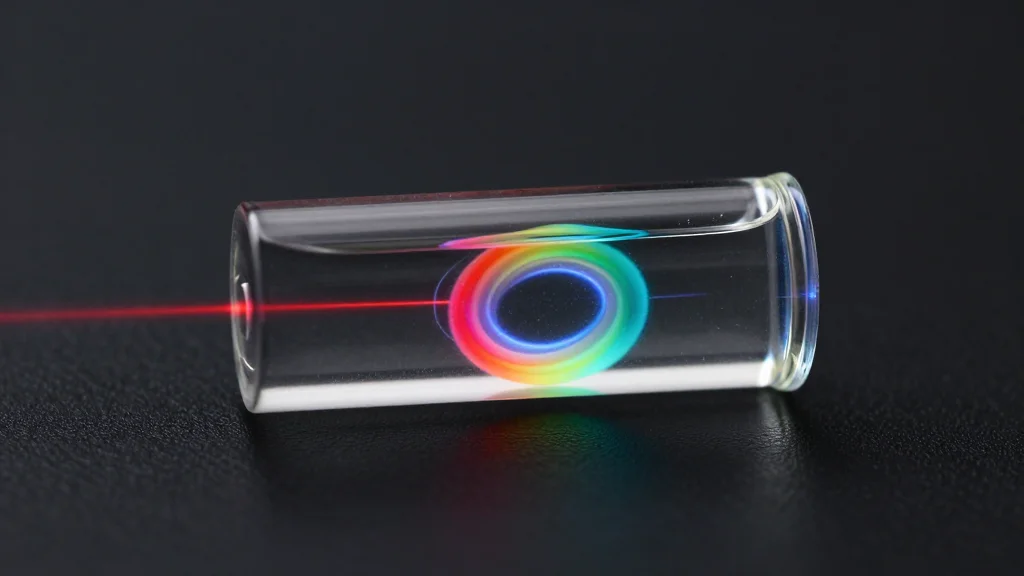
The breakthrough reported by Q. Shi and colleagues hinges on a ‘pretwisting’ step that primes the liquid crystal for skyrmion nucleation. By patterning the top surface with a straight line and the bottom with a swirl, then rotating the top pattern about 100° using linearly polarized light, the team introduced a controlled background twist in a 10‑µm‑thick cell. Subsequent application of any of three stimuli—laser illumination, an alternating electric field, or modest heating—triggered the emergence of bright, loop‑shaped skyrmions observable under polarized microscopy. The ability to switch with multiple inputs underscores a universal energy‑lowering pathway.
From a technology standpoint, the method demonstrates a low‑energy, multistimuli route to topological excitations that could inform the design of solid‑state memory elements. If the pretwisting principle can be translated to magnetic materials, it may reduce the power budget for skyrmion creation, easing integration into spintronic circuits. Moreover, the micrometer‑scale liquid‑crystal platform offers a rapid testbed for exploring skyrmion dynamics, interactions, and confinement effects before committing to costly nanofabrication. Continued cross‑disciplinary work could accelerate the transition from laboratory curiosities to commercial data‑storage solutions.
Liquid Crystals Offer On-Demand Skyrmions
Comments
Want to join the conversation?
Loading comments...