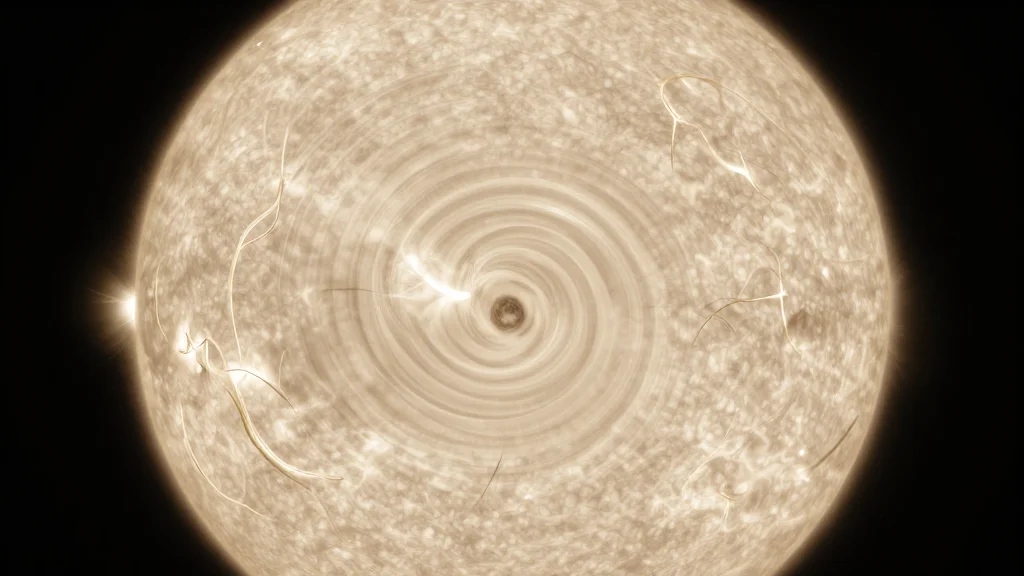
Listening to the Sun Reveals Previously Hidden Changes to Solar Cycle
Why It Matters
Accurate solar‑cycle forecasts improve space‑weather warnings, protecting satellites, power grids and communication networks from disruptive solar storms.
Key Takeaways
- •Acoustic waves detected earlier magnetic field reversal in solar interior
- •New cycle signs appear six months before sunspot increase
- •Findings refine solar dynamo models for next decade
- •Improved forecasts could mitigate satellite and grid disruption risks
- •Study combines ground-based GONG and spaceborne SDO data
Pulse Analysis
Solar physicists have long relied on sunspot counts and magnetic field measurements to track the 11‑year solar cycle, but those surface indicators miss many interior processes. In a new study, a team at the University of Birmingham turned to helioseismology—the study of acoustic waves that travel through the Sun’s plasma—to listen for subtle shifts in the solar interior. By cross‑referencing continuous observations from the ground‑based Global Oscillation Network Group (GONG) with high‑resolution imagery from NASA’s Solar Dynamics Observatory (SDO), the researchers detected an early reversal of the Sun’s internal magnetic field and a faint increase in acoustic power that precedes the emergence of new sunspots.
The ability to spot these hidden precursors reshapes how scientists forecast solar activity. An earlier detection of the next cycle’s onset gives space‑weather agencies more lead time to issue alerts for geomagnetic storms that can cripple satellite electronics, disrupt GPS navigation, and induce currents in power‑grid transformers. Financial analysts estimate that a severe solar event could cost the U.S. economy billions in lost productivity and infrastructure damage. By integrating acoustic‑wave diagnostics into existing prediction models, utilities and satellite operators can better hedge against such risks.
Looking ahead, the Birmingham team plans to expand the acoustic monitoring network and combine it with machine‑learning algorithms to refine cycle‑timing estimates. If successful, this approach could become a standard component of the global space‑weather early‑warning system, complementing traditional magnetogram data. Moreover, the findings deepen our understanding of the solar dynamo—a fundamental engine driving magnetic activity across the heliosphere—potentially informing research on stellar cycles beyond our own Sun. Investors and policymakers should watch these developments as they may influence the valuation of aerospace, telecommunications, and energy‑infrastructure assets.
Listening to the Sun Reveals Previously Hidden Changes to Solar Cycle
Comments
Want to join the conversation?
Loading comments...