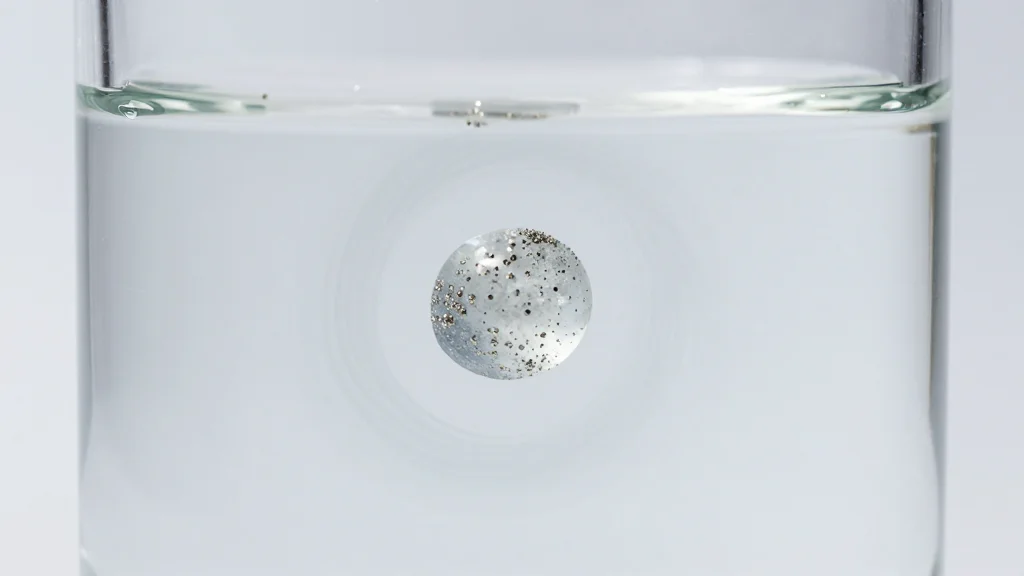
Macroscopic Convective Fluid Flows Arising From Binding of Ions and Small Molecules to Proteins
Why It Matters
The discovery provides a new, chemically‑powered method to translate molecular recognition into bulk fluid motion, enabling low‑energy fluidic actuation and highly selective sensing platforms for biotechnology and diagnostics.
Key Takeaways
- •Nickel binding to urease releases hydration water, creating density gradients
- •Buoyancy and diffusion coupling sustains directional macroscopic flow
- •Protein pumps discriminate nickel from complex ion mixtures
- •Binding‑induced flow can power flow‑based biosensors
Pulse Analysis
The ability of proteins to act as microscopic pumps stems from a simple physicochemical principle: when a ligand or metal ion binds, it perturbs the tightly ordered water molecules that surround the protein. This displacement injects less dense water into the bulk solution, generating a localized buoyancy force. By immobilizing the protein on a surface, the researchers harnessed this force to produce a continuous convective current that can be visualized at the millimeter scale. The work bridges the gap between molecular binding events, traditionally studied in static assays, and dynamic fluidic responses, offering a fresh perspective on active matter.
Beyond the fundamental insight, the study demonstrates practical selectivity. Nickel ions bind strongly to urease, while competing ions are largely ignored, allowing the protein‑based pump to act as a chemical filter. Computational models confirm that the flow magnitude scales with the number of displaced water molecules, linking binding affinity directly to fluid velocity. This relationship suggests that tuning protein‑ligand interactions could tailor flow rates for specific applications, from microfluidic mixing to targeted delivery in lab‑on‑a‑chip systems.
The implications for biosensing are especially compelling. Conventional sensors rely on optical or electrical readouts; here, a binding event produces a visible fluid motion, simplifying detection and reducing instrumentation costs. Such flow‑based sensors could operate in complex matrices, leveraging the pump’s inherent selectivity to isolate target ions like nickel. Moreover, the low energy requirement—derived solely from binding chemistry—makes the approach attractive for portable, battery‑free diagnostic devices, aligning with the growing demand for point‑of‑care technologies.
Macroscopic Convective Fluid Flows Arising From Binding of Ions and Small Molecules to Proteins
Comments
Want to join the conversation?
Loading comments...