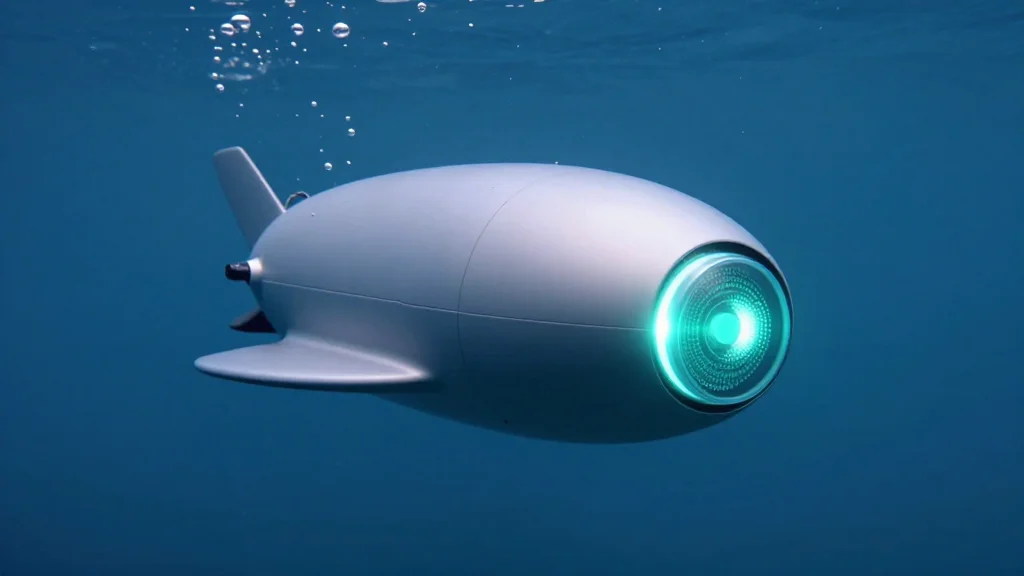
Magnetoelectric Antennas Could Transform How Underwater Robots Talk
Why It Matters
BlueME could eliminate the need for AUVs to surface for data transmission, enabling true real‑time autonomy and coordinated fleet operations in harsh underwater environments.
Key Takeaways
- •BlueME achieved 730 m communication in saltwater using <10 W power.
- •Magnetoelectric antenna array compresses wavelength, boosting efficiency underwater.
- •Data rates of 1‑100 Kb/s enable real‑time status updates for AUVs.
- •System works in both freshwater and saltwater, independent of turbidity.
- •Researchers filed provisional patent and seek funding for larger‑scale trials.
Pulse Analysis
Underwater communication has long been constrained by the physics of the medium. Radio waves attenuate rapidly in conductive seawater, acoustic links suffer from Doppler shift and marine‑life noise, and optical systems demand clear line‑of‑sight. These limitations force most autonomous underwater vehicles (AUVs) to surface periodically, breaking mission continuity and increasing operational costs. The industry therefore seeks a medium‑range, low‑power solution that can operate reliably regardless of water clarity or depth.
The BlueME system leverages magnetoelectric (ME) technology, coupling a magnetostrictive Metglas layer with a piezoelectric PZT layer to create a compact antenna that radiates efficiently at 35‑36 kHz. Submerging the antenna dramatically shortens the effective wavelength, turning a traditionally bulky very‑low‑frequency design into a manageable 3 × 5 array. In real‑world trials, the array delivered a 119 dB link budget improvement, sustaining 730 m communication in salty Gulf waters on under 10 W—roughly the power of a household LED. Data rates of up to 100 Kb/s, while modest, are sufficient for periodic telemetry and command updates, redefining what AUVs can achieve without surfacing.
If scaled, BlueME could reshape subsea operations across oil‑and‑gas, scientific research, and defense. Continuous, low‑latency links enable coordinated swarm behaviors, real‑time mapping, and adaptive mission planning, reducing the need for costly retrieval and redeployment cycles. The provisional patent and ongoing funding efforts suggest a near‑term path to commercial prototypes, positioning magnetoelectric antennas as a disruptive alternative to acoustic and optical systems in the growing underwater robotics market.
Magnetoelectric antennas could transform how underwater robots talk
Comments
Want to join the conversation?
Loading comments...