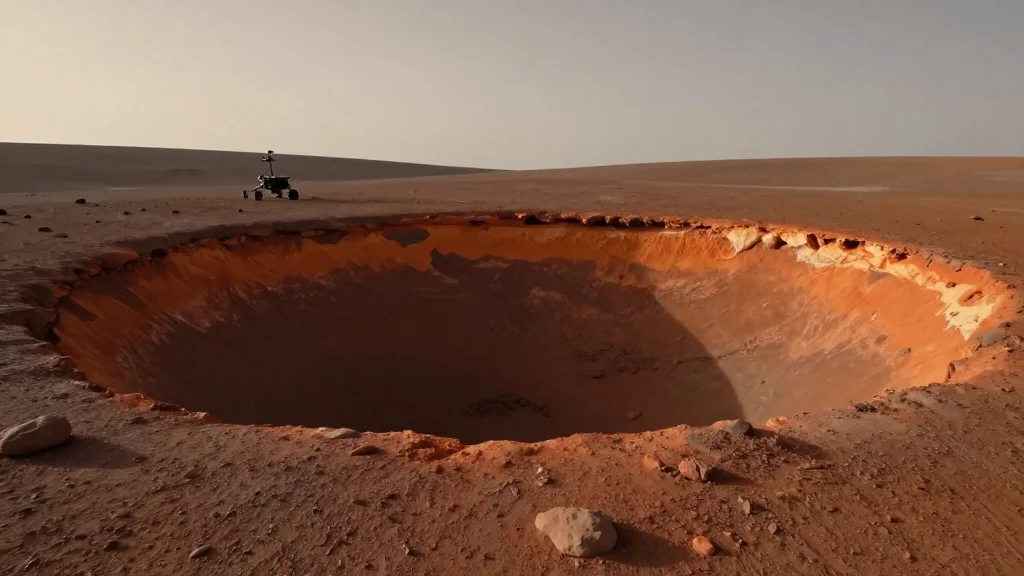
Mars's Manganese 'Bathtub Ring' Reveals Ancient Ocean Timeline and Its Potential for Life
Why It Matters
The discovery extends the window of habitable conditions on early Mars, aligning its timeline with Earth’s earliest life and reshaping models of Martian habitability. It also highlights manganese minerals as a potential in‑situ oxygen source for future crewed missions.
Key Takeaways
- •Manganese “bathtub ring” marks ancient shoreline in Utopia Planitia.
- •Ring indicates a stable Hesperian ocean lasting 0.8–1.5 Myr.
- •Deep‑learning SCANet analyzed 5.8 M SWIR spectra to map Mn distribution.
- •Findings suggest Mars once had conditions suitable for prebiotic chemistry.
Pulse Analysis
Manganese oxides and hydroxides have long been used on Earth as geological markers of past water‑air interfaces because they precipitate only when dissolved manganese meets oxygen. On Mars, the same chemistry creates a distinctive “bathtub ring” that outlines former shorelines, offering a rare glimpse into ancient hydrologic cycles that traditional crater‑count dating cannot resolve. By recognizing these mineral signatures, scientists can reconstruct the extent and longevity of water bodies that once covered the planet’s northern lowlands.
The new Nature Communications paper leverages a massive dataset of short‑wave infrared spectra collected by the Zhurong rover, ESA’s OMEGA, and NASA’s CRISM instruments. Researchers trained a Spectral Contrastive‑Aware Network (SCANet) to isolate the spectral fingerprints of manganese (hydr)oxides, processing 5.78 million spectra to produce a high‑resolution map of Mn concentration. The analysis shows a clear altitude‑dependent gradient, peaking at 7.4 wt % over a 10‑meter band before tapering off, which the authors interpret as a shoreline formed during the Hesperian epoch (≈3.7–3.0 billion years ago). Their calculations suggest the ocean persisted for 0.8–1.5 million years, a duration that exceeds most estimates for transient Martian surface water.
Beyond its geological significance, the finding reshapes the astrobiological narrative. A million‑year stable ocean provides enough time for prebiotic chemistry, aligning Mars’s habitability window with the era when life is thought to have emerged on Earth. Moreover, the identified manganese deposits could serve future explorers as a feedstock for photocatalytic water‑splitting, generating oxygen on‑site and supporting long‑duration human presence. The study thus bridges ancient planetary science with practical considerations for Mars colonization, underscoring the dual scientific and resource value of mineralogical investigations.
Mars's manganese 'bathtub ring' reveals ancient ocean timeline and its potential for life
Comments
Want to join the conversation?
Loading comments...