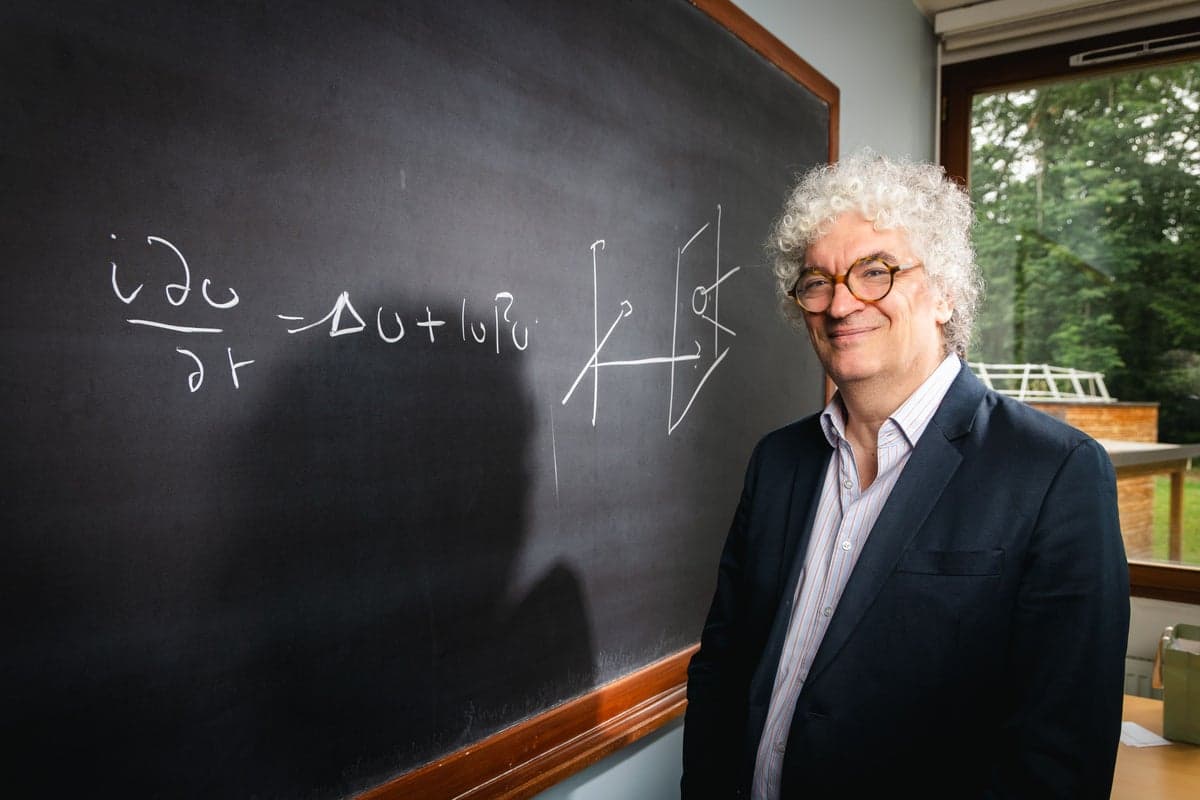
Master of Chaos Wins $3M Math Prize for ‘Blowing up’ Equations
Why It Matters
Understanding and controlling blowup in nonlinear equations impacts technologies ranging from high‑precision lasers to turbulence modeling, influencing both industry and fundamental physics. Merle’s soliton‑centric insights offer a tractable path to predict and harness chaotic systems.
Key Takeaways
- •Merle won the 2024 Breakthrough Prize in Mathematics ($3 M).
- •He proved soliton structures govern blowup in nonlinear laser equations.
- •His work shows friction cannot prevent singularities in compressible Navier‑Stokes.
- •Merle resolved the super‑critical nonlinear Schrödinger equation’s blowup conjecture.
Pulse Analysis
Frank Merle’s Breakthrough Prize win shines a spotlight on the practical relevance of abstract mathematics. By embracing the nonlinear core of equations rather than treating it as a perturbation, Merle uncovered that solitons—self‑stabilizing wave packets—act as the hidden scaffolding of chaotic systems. This perspective not only simplifies the analysis of complex phenomena but also provides engineers with concrete tools to predict outcomes in high‑energy laser design, where controlled blowup translates to tighter focus and greater efficiency.
In fluid dynamics, Merle’s proofs that friction does not avert singularities in compressible Navier‑Stokes equations reshape expectations for turbulence mitigation. While incompressible flow remains a Millennium Prize problem, his findings suggest that even adding realistic dissipative effects may not tame the underlying blowup mechanisms. This insight informs computational fluid‑dynamics models used in aerospace and climate simulations, prompting a reassessment of how turbulence is represented and controlled.
The quantum realm also feels the ripple of Merle’s work. His breakthrough on the super‑critical nonlinear Schrödinger equation demonstrates that, contrary to long‑standing belief, blowup can occur despite dispersive tendencies. This has implications for fields such as nonlinear optics and Bose‑Einstein condensate research, where managing singular behavior is crucial for device stability. Overall, Merle’s soliton‑resolution framework bridges theory and application, offering a unifying language that could accelerate innovation across laser technology, fluid engineering, and quantum physics.
Master of chaos wins $3M math prize for ‘blowing up’ equations
Comments
Want to join the conversation?
Loading comments...