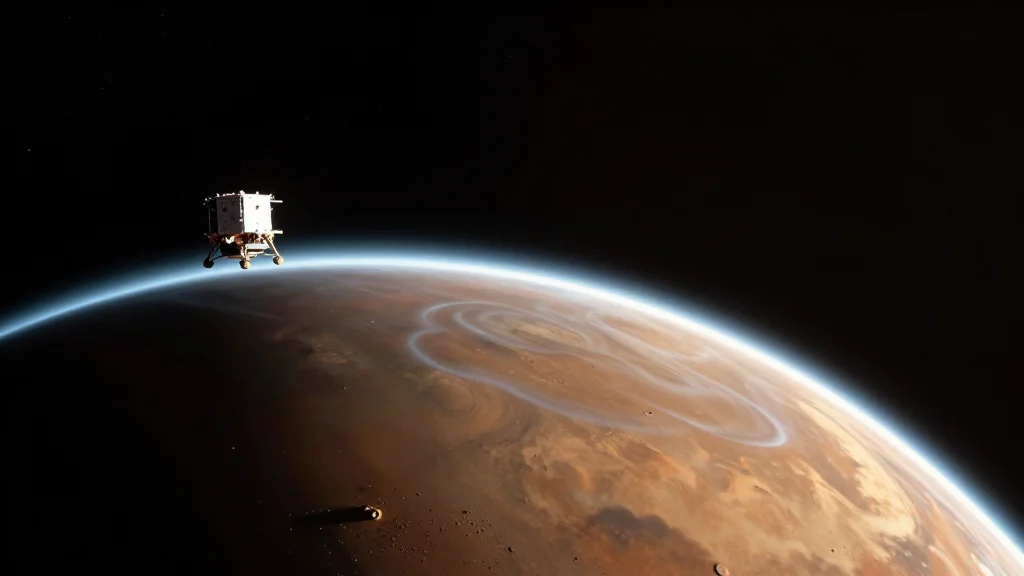
MAVEN Detects 'Zwan‑Wolf' Plasma Squeezing, New Mechanism for Mars Atmospheric Loss

Why It Matters
The identification of a toothpaste‑like plasma compression on Mars adds a missing piece to the puzzle of how the planet lost most of its early atmosphere. By revealing a rapid, storm‑driven loss channel, the discovery reshapes theories of Martian climate evolution and informs models of atmospheric retention on exoplanets exposed to frequent stellar flares. For mission planners, a better grasp of atmospheric variability improves predictions for entry, descent, and landing dynamics, directly impacting the safety and feasibility of future crewed missions. Beyond Mars, the Zwan‑Wolf effect highlights the need to consider mechanical plasma processes alongside chemical and sputtering mechanisms when assessing planetary habitability. As astronomers discover more Earth‑size worlds around active stars, the ability to predict atmospheric erosion will be a key factor in evaluating which planets might retain surface water and, by extension, life.
Key Takeaways
- •MAVEN observed plasma "wiggles" in Mars' ionosphere after a 2023 coronal mass ejection.
- •The phenomenon, named the Zwan‑Wolf effect, compresses atmospheric plasma like toothpaste.
- •Researchers propose the effect as a rapid, mechanical pathway for atmospheric escape.
- •Debate exists over how frequently the effect occurs and its overall contribution to loss.
- •Findings could revise models of Martian climate history and inform exoplanet studies.
Pulse Analysis
The Zwan‑Wolf effect arrives at a moment when planetary scientists are re‑examining the balance of forces that strip atmospheres from worlds without protective magnetic fields. Historically, MAVEN’s legacy has centered on quantifying sputtering—where solar wind particles physically knock atmospheric atoms into space—and photochemical escape driven by ultraviolet radiation. The new plasma‑squeezing mechanism adds a dynamic, short‑term driver that can spike loss rates by orders of magnitude during extreme solar events.
From a historical perspective, the discovery mirrors the 2015 revelation that Earth’s ionosphere can undergo similar compressions during geomagnetic storms, a finding that forced space‑weather forecasters to incorporate rapid density fluctuations into satellite drag models. Translating that lesson to Mars suggests that atmospheric loss is not a steady drizzle but a series of intense bursts, especially during solar maxima. This has profound implications for reconstructing Mars’ ancient climate: if burst events were frequent, the planet could have shed its early thick CO₂ envelope faster than previously estimated, narrowing the window for stable liquid water.
Looking ahead, the research community will likely pursue three parallel tracks. First, continuous monitoring of solar storms with MAVEN and complementary orbiters will establish a statistical baseline for Zwan‑Wolf occurrences. Second, comparative studies with Venus—another unmagnetized planet—could determine whether similar plasma compressions are universal or uniquely tied to Mars’ specific ionospheric composition. Third, exoplanet researchers will need to factor burst‑driven loss into habitability criteria for planets orbiting M‑dwarf stars, which are notorious for frequent, high‑energy flares. In sum, the Zwan‑Wolf effect not only fills a gap in our understanding of Martian atmospheric evolution but also broadens the toolkit for assessing atmospheric stability across the galaxy.
MAVEN Detects 'Zwan‑Wolf' Plasma Squeezing, New Mechanism for Mars Atmospheric Loss
Comments
Want to join the conversation?
Loading comments...