May 2026: What’s in the Southern Hemisphere Sky This Month?
Why It Matters
These nightly displays drive demand for telescopes, sky‑watching tours, and educational programs, bolstering the amateur‑astronomy market and related tourism revenue. Understanding the timing and visibility helps retailers and event planners target enthusiasts at peak interest.
Key Takeaways
- •Venus reaches magnitude –3.9, visible low northwest after sunset
- •Jupiter at –1.9 shows 34″ equatorial diameter, visible west after dark
- •Mercury peaks at –0.8, 5° above horizon before sunrise
- •Saturn rises before 3 a.m., 0.8 magnitude, 38″ ring span
- •Pyxis constellation links historic navigation tools like the compass and log‑line
Pulse Analysis
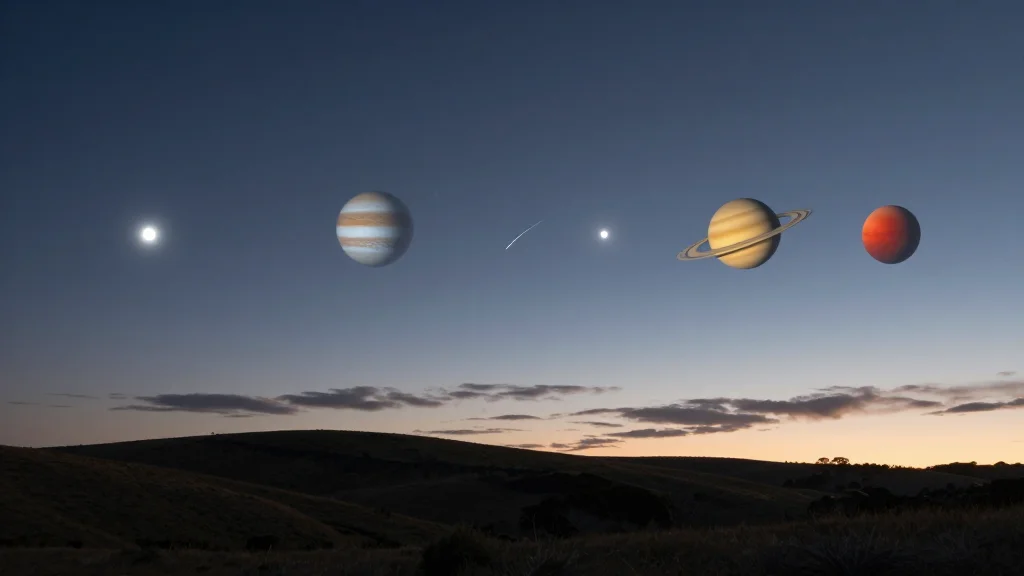
May’s night sky in the Southern Hemisphere delivers a planetary parade that amateur astronomers and tourism operators can leverage for increased engagement. Venus dominates the early evening horizon, climbing higher each night as it drifts eastward toward Gemini, while Jupiter’s steady westward march offers steady viewing of its cloud bands and four bright moons. Early‑morning observers will catch Mercury’s brief flash at –0.8 magnitude just before sunrise, followed by Saturn’s slow ascent that brings its iconic rings into view well before dawn. Mars, though modest in brightness, remains a reliable target for those tracking its gradual eastward motion against the Sun.
For the astronomy equipment market, this month’s lineup translates into heightened demand for portable telescopes, star‑maps, and smartphone apps that pinpoint optimal viewing windows. Sky‑watching tour operators in regions like South Africa, Australia, and Chile can schedule guided sessions around Venus’s low‑angle brilliance and Saturn’s pre‑dawn rise, offering premium experiences that command higher ticket prices. Educational institutions also benefit, using the clear planetary positions to teach orbital mechanics, magnitude scales, and the physics behind Jupiter’s polar flattening and Saturn’s ring tilt, thereby enriching STEM curricula and attracting sponsorships.
Beyond the planets, the guide revives the story of Pyxis, the compass constellation, and its forgotten companion Lochium Funis, the log‑and‑line used by sailors to measure speed. This historical tie underscores how celestial navigation shaped maritime trade and modern knot measurement, a narrative that resonates with heritage tourism and museum exhibits. By weaving astronomy with navigation lore, content creators can attract a broader audience interested in both science and cultural history, expanding reach across hobbyist forums, travel blogs, and educational platforms.
May 2026: What’s in the Southern Hemisphere sky this month?
Comments
Want to join the conversation?
Loading comments...