Measuring an Electron’s Magnetism in a Molecule
Why It Matters
Achieving sub‑10⁻¹⁰ precision for a bound electron provides a new arena to test QED and search for physics beyond the Standard Model, potentially reshaping fundamental constants and metrology standards.
Key Takeaways
- •Measured electron g‑factor in HD⁺ ion with 2×10⁻¹⁰ relative uncertainty.
- •Precision is 1,000× better than previous molecular measurements.
- •Result matches QED prediction for g, but coupling strengths deviate.
- •Technique uses single‑ion Penning trap and microwave spin‑flip spectroscopy.
- •Opens path for stringent tests of quantum electrodynamics in bound systems.
Pulse Analysis
The electron’s magnetic moment, encapsulated in its g‑factor, has long served as a benchmark for quantum electrodynamics. Free‑electron measurements have reached one part in 10¹³, setting a high bar for theory and experiment alike. Extending this precision to electrons bound within atoms or molecules is far more challenging because the surrounding nuclear environment perturbs the magnetic interaction. The recent HD⁺ study bridges that gap, delivering a bound‑electron g‑factor measurement with a relative uncertainty of 2 × 10⁻¹⁰, thereby entering a regime previously reserved for free particles.
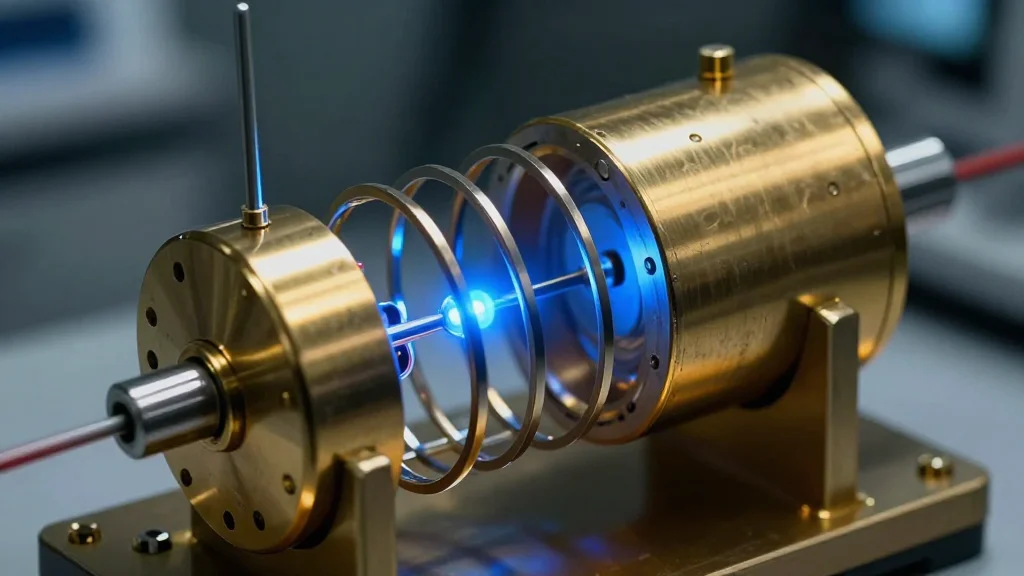
The experiment hinged on a single HD⁺ ion confined in a cryogenic Penning trap, where magnetic and electric fields isolate the ion from external disturbances. Researchers applied finely tuned microwave radiation to induce spin‑flip transitions while monitoring the ion’s motion to detect the flips. By systematically varying the microwave frequency across all possible proton‑deuteron spin configurations, they reconstructed the complete electron‑spin spectrum. Repeating the measurement hundreds of times per configuration yielded the unprecedented precision, and the analysis revealed that while the g‑factor conforms to QED expectations, the electron‑proton and electron‑deuteron hyperfine coupling constants diverge slightly from theoretical values.
These findings have far‑reaching implications. First, they validate that bound‑state spectroscopy can achieve free‑electron‑level accuracy, opening a new frontier for testing the limits of QED in complex systems. Second, the observed discrepancies in coupling strengths could hint at subtle effects not captured by current models, offering a potential window into physics beyond the Standard Model. Finally, the methodology sets a precedent for future high‑precision measurements of other molecular ions, which could refine fundamental constants and improve the accuracy of atomic clocks, quantum sensors, and other emerging technologies.
Measuring an Electron’s Magnetism in a Molecule
Comments
Want to join the conversation?
Loading comments...