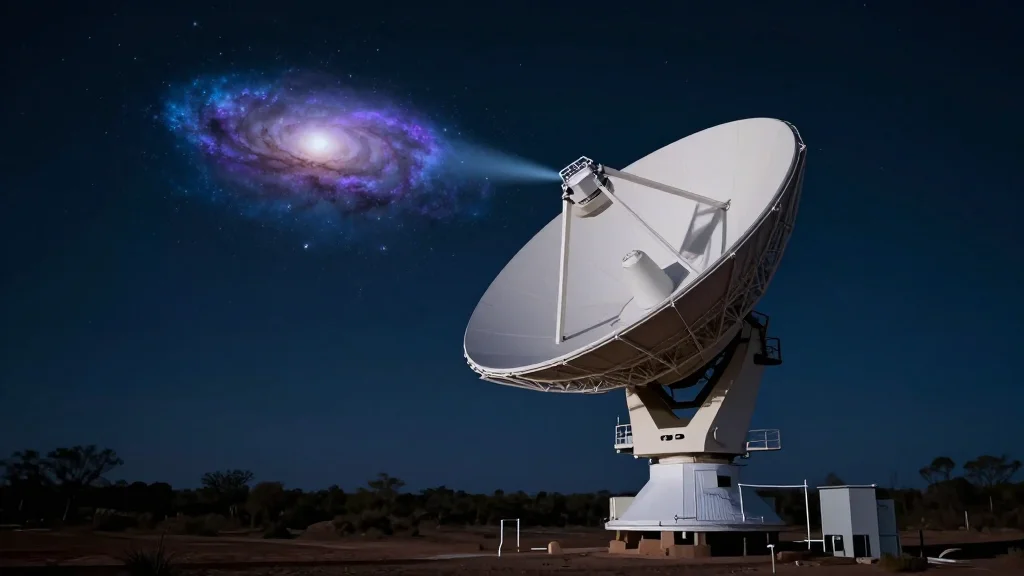
MeerKAT Detects Most Distant Hydroxyl Megamaser, 8 Billion Light‑Years Away

Why It Matters
The MeerKAT megamaser detection pushes the frontier of observational cosmology by proving that low‑frequency radio telescopes can capture extremely faint signals from the universe’s formative epochs. This capability will enable researchers to trace the history of galaxy mergers, star formation, and black‑hole growth across cosmic time, filling gaps left by optical and infrared surveys. Moreover, the find validates the design philosophy of next‑generation facilities like the SKA and ngVLA, showing that their unprecedented sensitivity will not only increase detection rates but also open entirely new classes of astrophysical phenomena for systematic study. As a result, the discovery accelerates the timeline for answering fundamental questions about how the first massive galaxies assembled.
Key Takeaways
- •MeerKAT detected a hydroxyl megamaser 8 billion light‑years away, the most distant ever observed
- •Signal was captured in just five hours thanks to gravitational lensing and MeerKAT’s wide bandwidth
- •Megamaser power is millions of times greater than typical galactic masers, bridging to gigamaser regime
- •Discovery demonstrates MeerKAT’s ability to uncover rare, faint low‑frequency phenomena without dedicated searches
- •Implications for SKA and ngVLA: future surveys could identify many more distant megamasers, enriching early‑universe studies
Pulse Analysis
The MeerKAT megamaser breakthrough arrives at a pivotal moment for radio astronomy. Historically, megamasers have been rare, discovered primarily in nearby ultra‑luminous infrared galaxies where intense star formation fuels the maser action. By pushing the detection horizon to 8 billion light‑years, the South African team has shown that the population of such extreme objects may be far larger than previously thought, hidden behind the limits of older instruments.
From a technical standpoint, the result highlights the power of combining high sensitivity with broad spectral coverage. MeerKAT’s design—originally intended as a SKA precursor—delivers exactly the kind of serendipitous discovery capability that next‑generation arrays promise. The fact that the signal emerged while the telescope was targeting neutral hydrogen illustrates a broader lesson: future surveys should adopt a multi‑line, data‑mining approach to maximize scientific return.
Strategically, the finding strengthens the case for rapid international collaboration between the SKA and ngVLA projects. While the SKA will dominate low‑frequency cosmology, the ngVLA’s higher‑frequency reach will enable complementary studies of molecular gas and dust in the same galaxies. Together, they could transform megamasers from curiosities into robust cosmological probes, potentially offering independent distance ladders and insights into the physics of galaxy mergers during the epoch of peak star formation. The MeerKAT result is therefore not just a singular observation; it is a proof‑of‑concept that could reshape survey strategies and scientific priorities for the next decade of radio astronomy.
MeerKAT Detects Most Distant Hydroxyl Megamaser, 8 Billion Light‑Years Away
Comments
Want to join the conversation?
Loading comments...