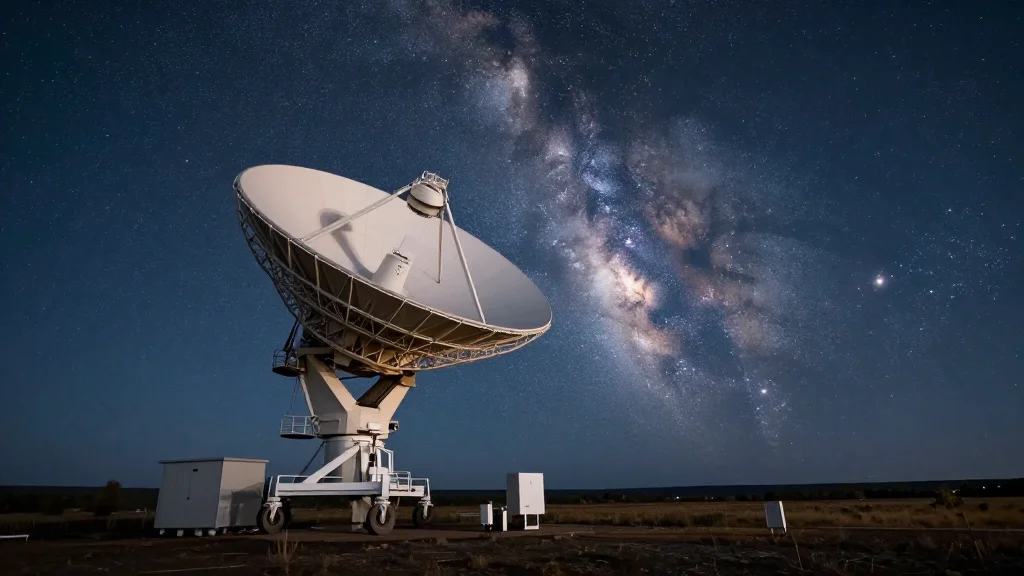
MeerKAT Maps Hidden Vela Supercluster, Adding 2,000 Galaxies to Cosmic Census

Why It Matters
Mapping the Vela supercluster resolves a major blind spot in our view of the nearby universe, allowing scientists to account for a significant portion of the mass that influences galaxy motions. Accurate mass inventories are essential for testing theories of dark matter and dark energy, and for calibrating measurements of cosmic expansion. Beyond cosmology, the discovery demonstrates the power of radio telescopes to explore obscured regions of the sky, setting a precedent for future surveys that will rely on facilities like the Square Kilometre Array. By revealing where cold hydrogen gas resides, the work also informs models of future star formation and galaxy evolution in environments previously hidden from view.
Key Takeaways
- •MeerKAT radio telescope detected neutral hydrogen from >2,000 galaxies behind the Milky Way’s dust lane.
- •The Vela supercluster spans ~300 million light‑years and lies ~800 million light‑years away.
- •Estimated mass of the structure is ~3 × 10¹⁶ solar masses, making it one of the most massive nearby features.
- •Two dense cores within Vela appear to be moving toward each other, indicating ongoing gravitational interaction.
- •Findings will be integrated into cosmological models to refine local cosmic flow and dark matter distribution.
Pulse Analysis
The Vela supercluster’s emergence from the Zone of Avoidance marks a turning point for observational cosmology. For decades, astronomers relied on indirect gravitational signatures to infer hidden mass, but the radio‑based approach provides a direct census of galaxies and their gas content. This shift mirrors the broader transition from optical to multi‑wavelength surveys, where radio facilities now complement space‑based infrared missions to deliver a more complete picture of the universe.
Historically, the discovery of massive superclusters has reshaped our understanding of large‑scale structure, from the Great Wall to the Sloan Great Wall. Vela adds a new, massive node that sits relatively close to the Milky Way, meaning its gravitational pull can measurably affect the velocities of nearby galaxies. Incorporating Vela into flow models could reduce residuals that have long puzzled researchers, potentially narrowing the gap between local and cosmic measurements of the Hubble constant.
Looking ahead, the synergy between MeerKAT and next‑generation observatories promises to unlock further hidden structures. As the Square Kilometre Array comes online, its unprecedented sensitivity will likely reveal even fainter filaments and voids, refining the cosmic web’s map. The Vela breakthrough thus serves as both a proof of concept and a catalyst for a new era of radio‑driven cosmology, where the universe’s darkest corners become accessible to precise measurement.
MeerKAT Maps Hidden Vela Supercluster, Adding 2,000 Galaxies to Cosmic Census
Comments
Want to join the conversation?
Loading comments...