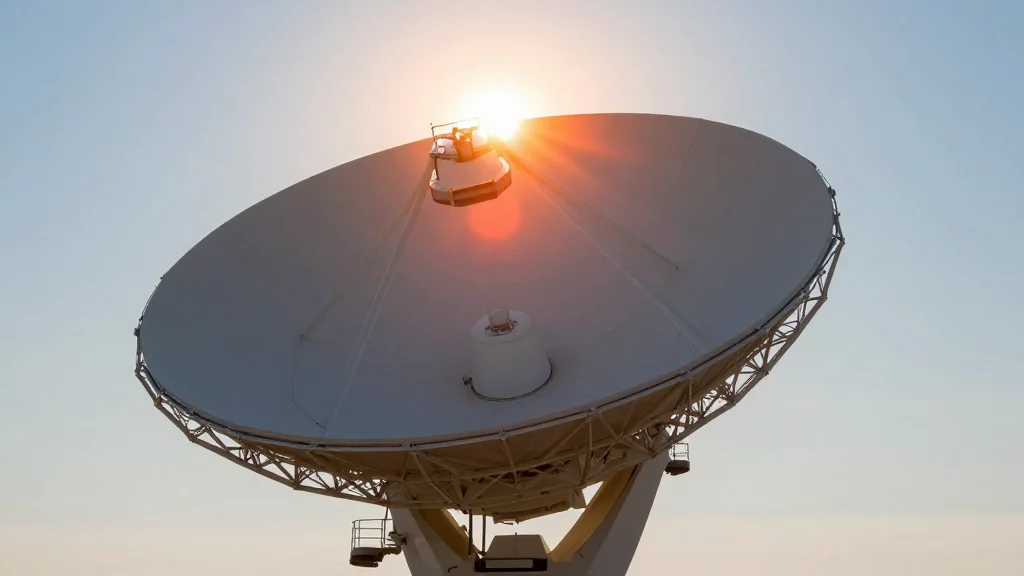
MeerKAT Reveals Three Electron Acceleration Sites in One Solar Flare
Why It Matters
The findings prove that solar flares can accelerate electrons in fragmented, multi‑site regions, refining models of particle energisation and improving space‑weather forecasts. MeerKAT’s capability demonstrates a new, powerful tool for solar physics, paving the way for SKA‑Mid investigations.
Key Takeaways
- •MeerKAT achieved >1,000 dynamic range across 0.8‑1.7 GHz band
- •Three distinct coherent radio sources map to separate magnetic structures
- •Diffuse incoherent emission reveals hot, low‑density plasma invisible to EUV
- •Multi‑instrument analysis links radio sources with hard‑X‑ray bremsstrahlung
- •Findings support fragmented reconnection over single‑site acceleration models
Pulse Analysis
Radio imaging spectroscopy has long been hampered by limited dynamic range, preventing simultaneous observation of bright bursts and faint background emission. MeerKAT, a 64‑dish interferometer in South Africa, overcomes these constraints with its dense uv‑coverage and exceptional sensitivity. By scanning the 0.8‑1.7 GHz band during an M1.3 flare, the array produced vector dynamic spectra for each spatial component, a capability previously reserved for much larger facilities. This technical leap enables solar physicists to dissect the radio signature of energetic electrons with unprecedented clarity.
The study identified three coherent radio sources, each anchored to a distinct coronal loop revealed by magnetic‑field extrapolations. Their independent spectral evolutions imply that electron acceleration occurs in multiple, possibly intermittent reconnection sites rather than a single dominant region. Such fragmented acceleration aligns with modern three‑dimensional reconnection theories, which predict a cascade of small‑scale current sheets. By correlating these radio sources with concurrent hard‑X‑ray bremsstrahlung, the researchers confirmed that each site hosts its own high‑energy electron population, strengthening the multi‑site acceleration narrative.
Beyond the bright bursts, MeerKAT detected diffuse incoherent emission extending past EUV‑visible structures, exposing hot, low‑density plasma that EUV imagers miss. This hidden thermal component suggests that flare energy budgets derived from EUV alone may underestimate the total thermal content. The ability to capture both thermal and non‑thermal radio signatures positions MeerKAT—and eventually the Square Kilometre Array—as a cornerstone for next‑generation solar monitoring, with direct benefits for space‑weather prediction and the protection of satellite and communication infrastructure.
MeerKAT reveals three electron acceleration sites in one solar flare
Comments
Want to join the conversation?
Loading comments...