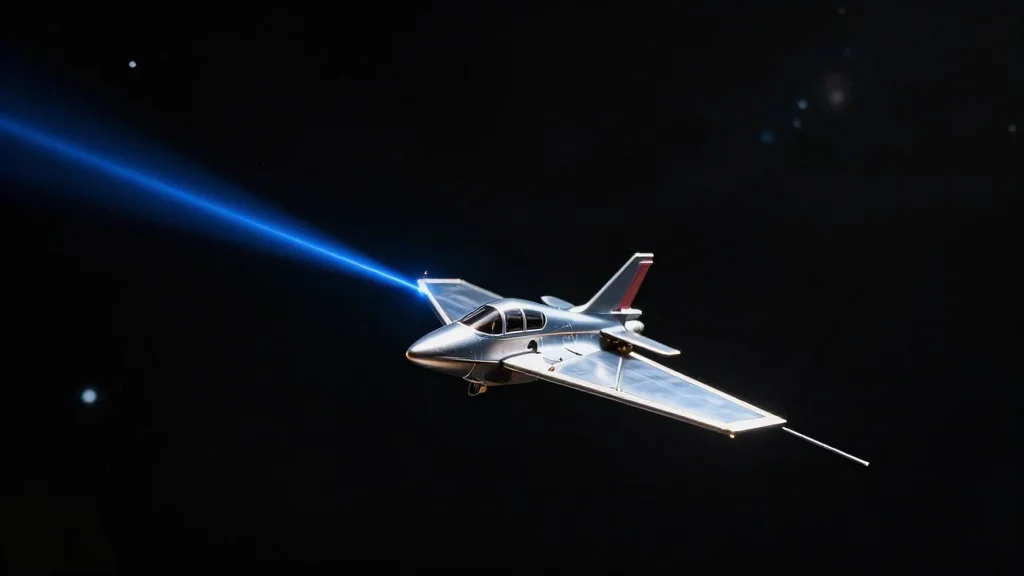
Metajets Use Light to Steer Interstellar Sails, Texas A&M Shows

Why It Matters
Precise steering is the missing piece in the puzzle of laser‑driven interstellar travel. Without a reliable method to adjust a sail’s trajectory, even the most powerful laser arrays could miss their intended destinations, rendering multi‑year missions ineffective. Metajets provide a lightweight, scalable solution that could make autonomous navigation feasible for gram‑scale probes, dramatically expanding the scientific return of missions like Breakthrough Starshot. Beyond interstellar ambitions, the ability to manipulate objects with light at micro‑scale has broader implications for satellite servicing, debris removal, and formation‑flying constellations. If metajets can be integrated into existing spacecraft architectures, they could reduce reliance on chemical propellants, lowering launch mass and extending mission lifetimes. The technology therefore sits at the intersection of propulsion, optics, and micro‑fabrication, promising cross‑disciplinary advances.
Key Takeaways
- •Texas A&M researchers created a silicon "metajet" that steers light sails via refraction.
- •Metajet mass is under a microgram, enabling thrust without significant weight penalty.
- •Laboratory tests achieved lateral sail displacement of 0.2 mm/s using adjustable lasers.
- •The technology addresses a critical navigation gap for laser‑propelled interstellar probes.
- •An on‑orbit demonstration is planned for late 2026 to validate space‑environment performance.
Pulse Analysis
The metajet breakthrough arrives at a pivotal moment for laser propulsion. Over the past decade, the field has been dominated by acceleration‑only concepts, leaving steering as a theoretical afterthought. By demonstrating bidirectional thrust with a device that adds virtually no mass, Kudtarkar’s team shifts the conversation from "can we reach another star?" to "can we reliably get there?" This transition mirrors the evolution of early rocketry, where guidance systems eventually became as critical as thrust.
Historically, attempts to steer light sails have relied on differential reflectivity or magnetic fields, both of which introduce engineering complexity and power constraints. Metajets sidestep these issues by exploiting the same laser infrastructure used for acceleration, turning the propulsion system into a dual‑purpose navigation tool. If the upcoming CubeSat test confirms laboratory performance, we could see a rapid cascade of funding toward integrated laser‑sail missions, with private investors and government agencies sharing the risk.
Looking ahead, the real test will be scaling the technology to the power levels required for a Breakthrough‑Starshot‑type launch, where gigawatt‑class lasers are envisioned. Thermal management, laser beam jitter, and sail material durability will become decisive factors. Nonetheless, the metajet concept provides a concrete engineering pathway that could shorten the timeline for humanity’s first interstellar probe from decades to a few years, fundamentally altering the strategic calculus for deep‑space exploration.
Metajets Use Light to Steer Interstellar Sails, Texas A&M Shows
Comments
Want to join the conversation?
Loading comments...