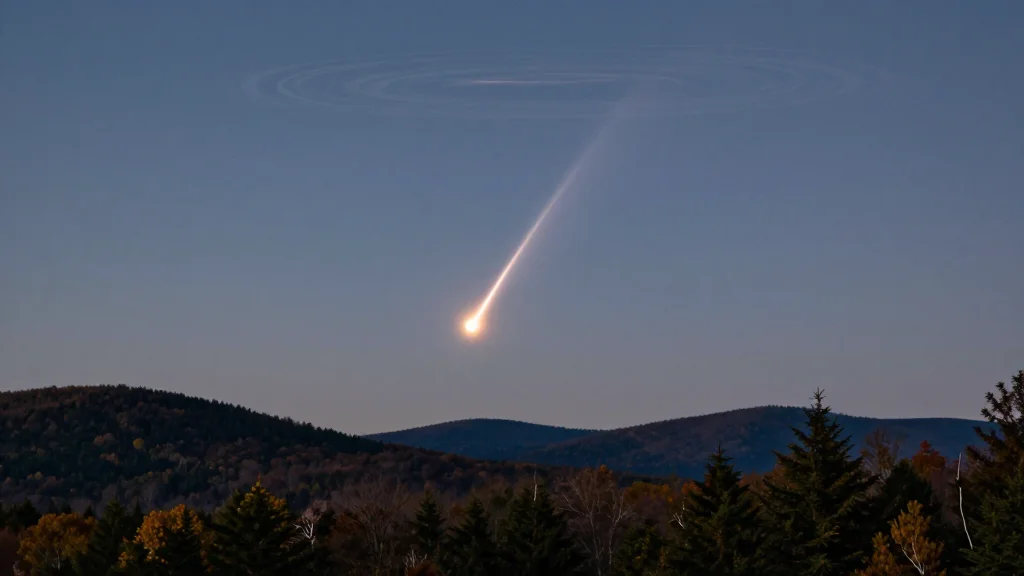
Meteor over Massachusetts Causes Explosion Reports, Sightings From Delaware to Montreal
Why It Matters
The event highlights the need for coordinated civilian reporting and rapid agency response to atmospheric phenomena that can cause public alarm. It also underscores the value of real‑time monitoring networks for distinguishing meteoric events from seismic activity.
Key Takeaways
- •Meteor ~1 m wide entered atmosphere over New Hampshire border.
- •Double booms felt from Delaware to Montreal, no earthquake detected.
- •NASA estimates 300‑ton TNT energy release at 75,000 mph speed.
- •Fragmentation occurred ~40 miles altitude; likely burned up before impact.
- •American Meteor Society logged dozens of sighting reports across region.
Pulse Analysis
Meteors of this size are relatively rare, but they provide a natural laboratory for studying high‑velocity atmospheric entry. When a meteoroid fragments at tens of kilometers altitude, the kinetic energy converts to a shockwave that can be heard and felt over a wide area, as seen in the recent New England event. Scientists use such occurrences to refine models of ablation, fragmentation, and energy deposition, which improve predictions for both natural and artificial objects entering the atmosphere.
The public’s reaction to the double boom illustrates how quickly a celestial event can trigger emergency protocols. Police, seismic monitoring agencies, and NASA coordinated to verify that the phenomenon was not a man‑made explosion or an earthquake. Platforms like the American Meteor Society and the USGS’s “Did you feel it?” portal enable crowdsourced data collection, turning eyewitness accounts into valuable scientific inputs. This collaborative approach reduces misinformation and helps authorities allocate resources efficiently during sudden, high‑impact events.
Looking ahead, the incident reinforces the importance of expanding space‑situational awareness infrastructure. With the growing number of satellites and debris, distinguishing natural meteors from artificial re‑entries becomes critical for both safety and regulatory compliance. Enhanced radar coverage, optical networks, and rapid data sharing can provide earlier warnings, allowing communities to prepare for potential shockwaves. Moreover, each well‑documented fireball adds to a global database that informs planetary defense strategies and deepens our understanding of near‑Earth objects.
Meteor over Massachusetts causes explosion reports, sightings from Delaware to Montreal
Comments
Want to join the conversation?
Loading comments...