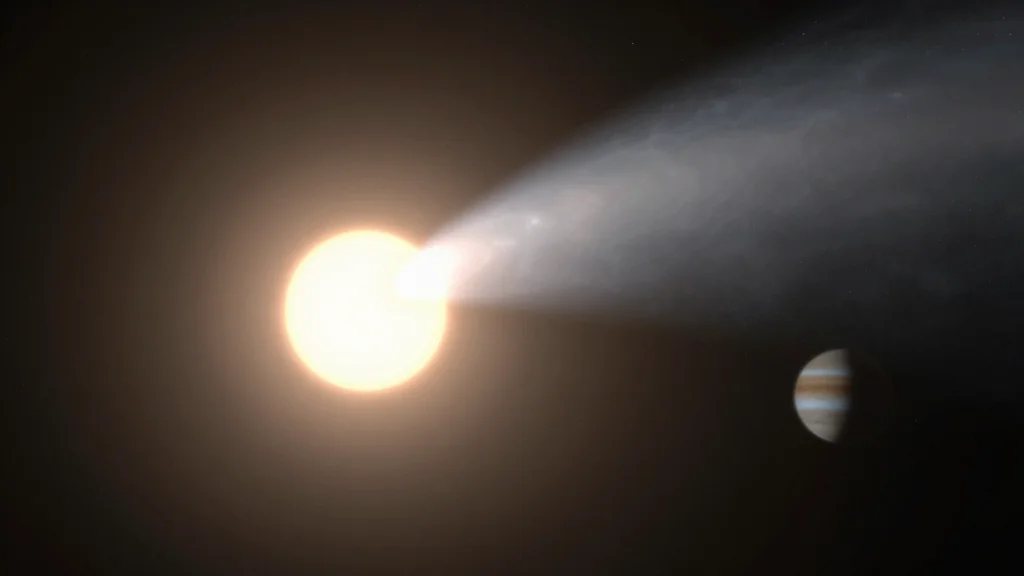
Methane Emerges From Interstellar Comet 3I/ATLAS as It Exits the Solar System
Why It Matters
Detecting methane from an interstellar comet provides direct chemical evidence of planetesimal formation beyond our solar system, refining models of planetary system diversity. The data help astronomers benchmark exoplanetary building blocks against our own solar system’s history.
Key Takeaways
- •3I/ATLAS is the third confirmed interstellar comet observed
- •JWST detected rising methane emissions as the comet warmed
- •Methane outgassing reveals interior composition beyond irradiated surface
- •Comet's size exceeds one kilometre, enabling detailed spectroscopic study
- •Future JWST observations aim to map dust and volatile inventory
Pulse Analysis
Interstellar visitors are among the most coveted targets for planetary science because they carry unaltered material from distant star systems. Prior to 3I/ATLAS, only 1I/'Oumuamua and 2I/Borisov offered limited insight—'Oumuamua behaved like an asteroid, while Borisov was a faint comet. ATLAS’s bright coma and kilometre‑scale nucleus created an unprecedented opportunity for high‑resolution spectroscopy, allowing researchers to compare its volatile mix with that of native solar system comets.
The James Webb Space Telescope’s Mid‑Infrared Instrument captured a clear rise in methane (CH₄) emission as ATLAS receded from the Sun. This surge signals that solar heating stripped away a thin, radiation‑processed crust, exposing deeper, less‑altered ices. Methane, a highly volatile compound, is scarce in many solar system comets, so its abundance hints at a formation zone rich in carbon‑bearing ices, possibly beyond the snow line of its home system. By mapping water, carbon dioxide, and dust alongside methane, scientists can reconstruct the temperature and chemical gradients that shaped the comet’s parent protoplanetary disk.
Beyond the immediate discovery, ATLAS reshapes how astronomers approach exoplanetary chemistry. The volatile inventory serves as a benchmark for the building blocks that may seed planets elsewhere, informing models of atmospheric composition and habitability. Continued JWST monitoring, despite the comet’s fading brightness, will refine measurements of dust grain size and organic content, feeding into broader surveys of interstellar debris. As more interstellar objects are identified, the synergy between rapid‑response observations and next‑generation telescopes promises to turn these fleeting visitors into a systematic probe of planetary formation across the galaxy.
Methane emerges from interstellar comet 3I/ATLAS as it exits the solar system
Comments
Want to join the conversation?
Loading comments...