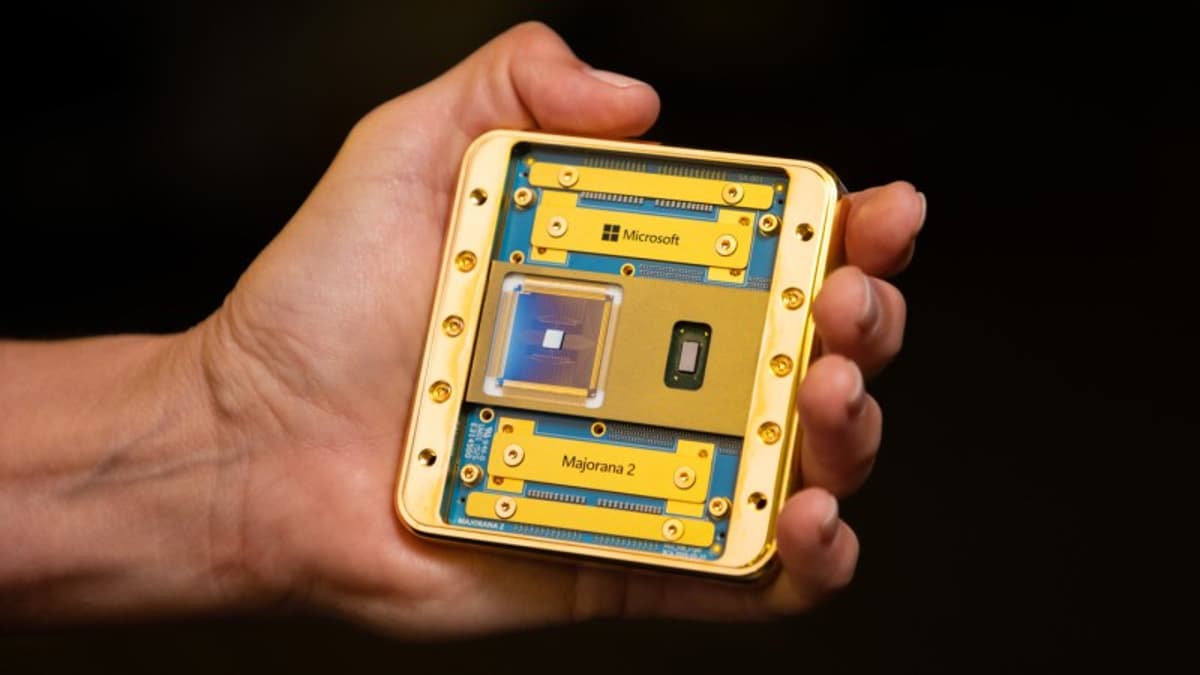
Microsoft’s Quantum Chip Got an Upgrade. Critics Are Still Skeptical
Companies Mentioned
Why It Matters
A reliable, error‑resilient qubit could shorten the path to practical quantum computers, but lingering skepticism may delay industry adoption and funding.
Key Takeaways
- •Parity lifetime increased from milliseconds to ~20 seconds.
- •Lead replaces aluminum as superconductor in qubit wires.
- •Improvement represents >1000× boost in topological qubit metric.
- •Critics note absence of X‑basis measurements, questioning qubit validity.
- •If verified, could accelerate error‑resilient quantum computing roadmap.
Pulse Analysis
Quantum computing’s biggest hurdle remains error mitigation, where even tiny disturbances can corrupt calculations. Microsoft has long pursued a topological route, leveraging Majorana quasiparticles that theoretically encode data non‑locally, making it inherently protected from noise. After mixed reception to its earlier prototype, the company announced a material swap—replacing aluminum with lead—in its superconducting nanowires, a move designed to extend the parity lifetime, a key indicator of qubit stability.
The new chip reports a parity lifetime of roughly 20 seconds, up from the millisecond range of its predecessor, translating to more than a thousand‑fold improvement. Researchers attribute this leap to the higher critical temperature and reduced quasiparticle poisoning of lead, which sustains the even‑odd electron parity essential for topological protection. Such a dramatic increase, if reproducible, could bring error‑corrected operations within reach, narrowing the gap between experimental labs and commercial quantum processors.
Nonetheless, the scientific community remains cautious. The preprint only showcases Z‑basis measurements, omitting the complementary X‑basis tests required to unequivocally confirm Majorana behavior. Critics argue that without this evidence, claims of a functional topological qubit are premature. As the quantum race intensifies, Microsoft’s progress will be closely watched; validation could attract significant investment, while continued doubts may shift focus toward alternative error‑correction architectures.
Microsoft’s quantum chip got an upgrade. Critics are still skeptical
Comments
Want to join the conversation?
Loading comments...