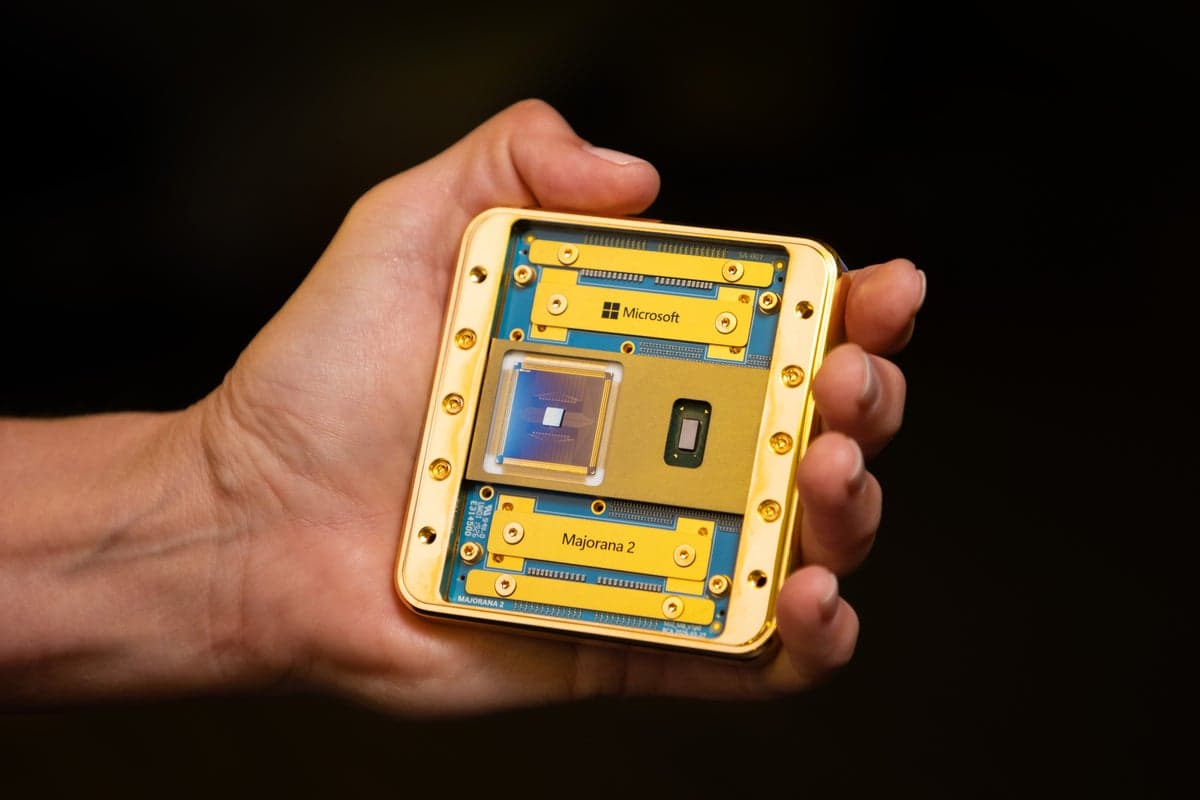
Microsoft’s Upgraded Majorana Quantum Computing Chip Fizzles with Physicists
Companies Mentioned
Why It Matters
If validated, the technology could give Microsoft a competitive edge in the multibillion‑dollar quantum race; the skepticism, however, highlights the gap between corporate hype and scientific verification, affecting investor confidence and industry timelines.
Key Takeaways
- •Microsoft unveiled Majorana 2 chip claiming up to minute-long qubit coherence.
- •Physicists criticize the preprint for single‑device data and lack of peer review.
- •Prior Majorana 1 claim was retracted after data misinterpretation.
- •Microsoft targets scalable, practical quantum computing by 2029 despite doubts.
Pulse Analysis
The quantum computing field is increasingly dominated by approaches that promise error‑resilient qubits. Topological qubits, based on elusive Majorana quasiparticles, have long been touted as a path to longer coherence times, a critical metric for scaling quantum processors. While companies like Google and IBM focus on superconducting transmons, Microsoft’s strategy hinges on manipulating exotic particles in ultra‑cold lead‑based wires, a route that could, in theory, compress millions of qubits onto a single chip and reshape the competitive landscape.
Microsoft’s latest Majorana 2 announcement reignites a familiar pattern of bold claims followed by scientific pushback. The preprint supporting the chip swaps aluminum for lead to widen the so‑called topological gap, asserting qubit lifetimes of 20 seconds to a minute. However, reviewers note that the data derive from a handful of measurements on a single device and lack independent replication, falling short of the rigorous standards of peer‑reviewed quantum research. The episode recalls the 2021 retraction of a Nature paper from Microsoft’s quantum team, underscoring persistent doubts about the reproducibility of its topological qubit experiments.
For investors and industry watchers, the saga matters because quantum technology is projected to become a multitrillion‑dollar market within the next decade. A credible breakthrough could catapult Microsoft ahead of rivals and justify its sizable R&D spend, while continued skepticism may delay adoption and shift capital toward more proven platforms. As Microsoft targets a 2029 demonstration of scalable, practical quantum computing, the company must bridge the gap between internal milestones and external validation to sustain confidence and secure its place in the emerging quantum ecosystem.
Microsoft’s upgraded Majorana quantum computing chip fizzles with physicists
Comments
Want to join the conversation?
Loading comments...