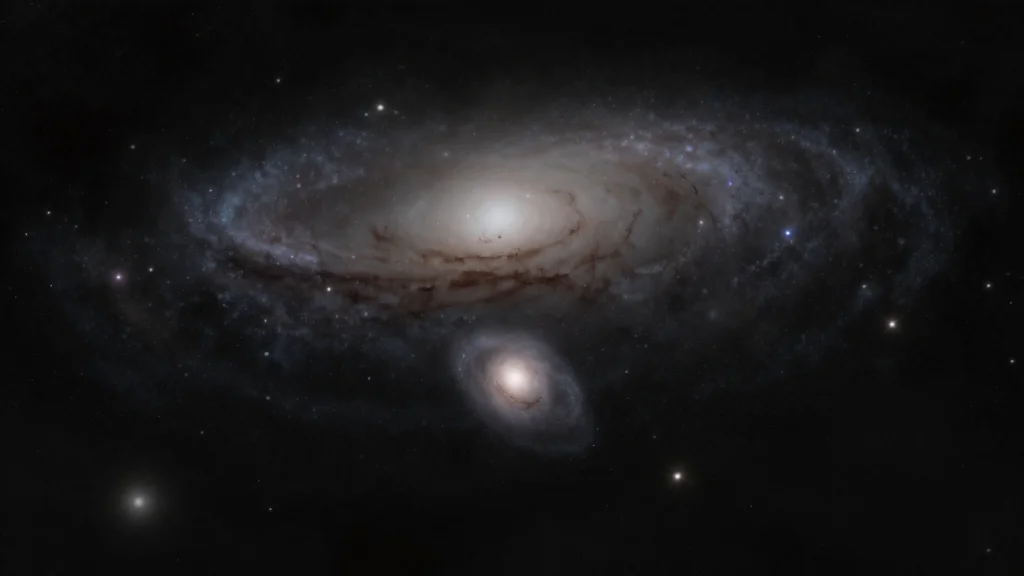
Milky Way’s “Little Cousins” May Hold Clues About Infant Universe
Why It Matters
Understanding dwarf satellites refines models of galaxy evolution and dark‑matter distribution, offering a tangible window into the universe’s first billion years.
Key Takeaways
- •Dwarf satellites preserve chemical signatures of early star formation
- •Hubble imaging maps stellar ages across Milky Way’s faint companions
- •Findings bolster hierarchical models of galaxy assembly in the early universe
- •Results tighten constraints on dark matter halo structures around dwarf galaxies
- •Insights aid interpretation of distant, high‑redshift galaxy observations
Pulse Analysis
The Milky Way’s entourage of dwarf galaxies has long been a curiosity for astronomers, but recent observations elevate them to cosmic time‑capsules. These low‑mass systems, often overlooked amid the Galaxy’s bright spiral arms, retain the elemental fingerprints of the first stars. By leveraging the Hubble Space Telescope’s sharp vision, researchers charted the ages and metallicities of stars within dozens of satellites, uncovering a prevalence of ancient, metal‑poor populations that echo the conditions prevailing less than a billion years after the Big Bang.
The study’s findings dovetail with the hierarchical framework of galaxy formation, wherein small structures merge to build larger ones. The dwarf galaxies’ star‑formation histories suggest they formed rapidly and then quenched, likely due to reionization and internal feedback. Moreover, the measured velocity dispersions and spatial distributions provide tighter constraints on the surrounding dark‑matter halos, sharpening our picture of how invisible mass scaffolds shape visible matter. These insights bridge the gap between nearby, observable dwarfs and the faint, high‑redshift galaxies captured by deep‑field surveys.
Beyond academic intrigue, the research informs future missions targeting the early universe. As next‑generation observatories like the James Webb Space Telescope and the Nancy Grace Roman Space Telescope probe ever‑more distant galaxies, the Milky Way’s dwarfs serve as local laboratories for calibrating models of star formation, chemical enrichment, and dark‑matter behavior. The synergy between nearby dwarf studies and high‑redshift observations promises to accelerate breakthroughs in cosmology, astrophysics, and the technologies that underpin them.
Milky Way’s “Little Cousins” May Hold Clues About Infant Universe
Comments
Want to join the conversation?
Loading comments...