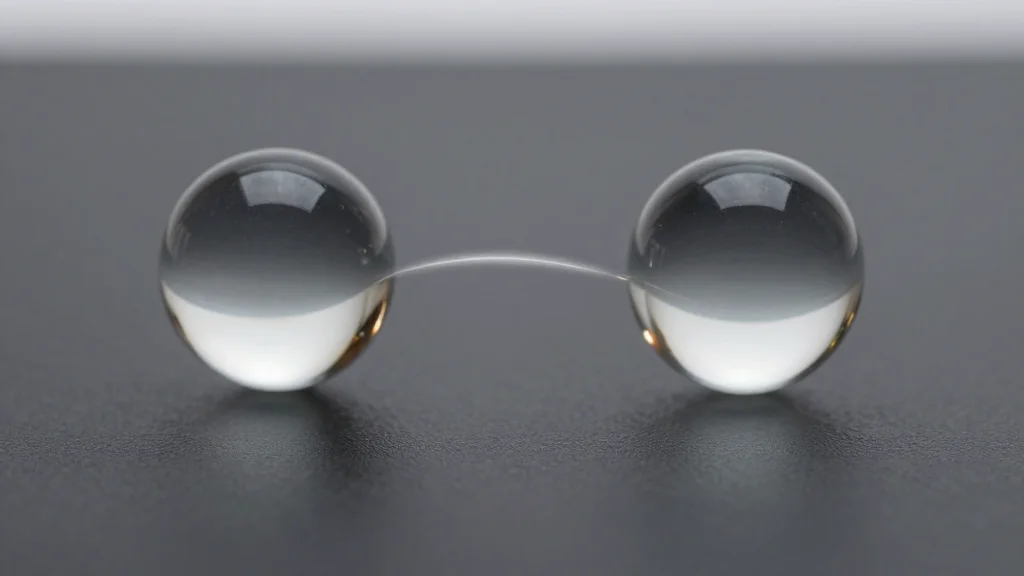
Mirror-Positioning Method Could Make Quantum Gravity Tests Possible
Why It Matters
Detecting gravity‑induced entanglement would provide the first direct evidence that gravity follows quantum mechanics, a milestone for fundamental physics and future quantum technologies.
Key Takeaways
- •Momentum‑squeezed state expands mirror superposition, boosting entanglement signal
- •Optomechanical cavity technique uses laser readout and optimal filtering
- •Proposed method is theoretically viable with existing cryogenic and vacuum tech
- •Detecting gravity‑induced entanglement would confirm quantum nature of gravity
- •Collaboration spans Kyushu University and Caltech, highlighting international effort
Pulse Analysis
The quest to reconcile general relativity with quantum mechanics has long hinged on experimental evidence that gravity itself can exhibit quantum behavior. Among the most promising avenues is gravity‑induced entanglement, where two isolated masses become linked solely through their mutual gravitational field. Detecting such entanglement is notoriously difficult because the gravitational coupling between laboratory‑scale objects is exceedingly weak, demanding ultra‑precise control of mechanical motion and suppression of thermal noise. Recent theoretical work from Kyushu University and Caltech proposes a practical route to amplify the entanglement signal, bringing the long‑standing test within experimental reach.
The proposed scheme exploits a momentum‑squeezed state in a cavity optomechanical system. By injecting laser light into an optical cavity and performing continuous homodyne detection, the researchers can apply optimal filtering to suppress thermal fluctuations and narrow the momentum uncertainty of a movable mirror. This deliberate squeezing expands the mirror’s position superposition, effectively increasing the spatial overlap that gravity can act upon. The broader superposition translates into a stronger differential mechanical mode between two nearby mirrors, magnifying the entanglement signature that would otherwise be buried in noise.
If experimentalists can realize this momentum‑squeezed configuration in low‑temperature, high‑vacuum environments—or even in space‑based platforms—the resulting observation of gravity‑induced entanglement would constitute direct proof that gravity obeys quantum rules. Such a breakthrough would reshape foundational physics, informing quantum field theories of spacetime and guiding the development of quantum‑enabled sensors and communication devices that leverage gravitational interactions. Moreover, the interdisciplinary collaboration underscores a growing convergence of photonics, cryogenics, and fundamental theory, signaling a new era of testable quantum‑gravity research.
Mirror-positioning method could make quantum gravity tests possible
Comments
Want to join the conversation?
Loading comments...