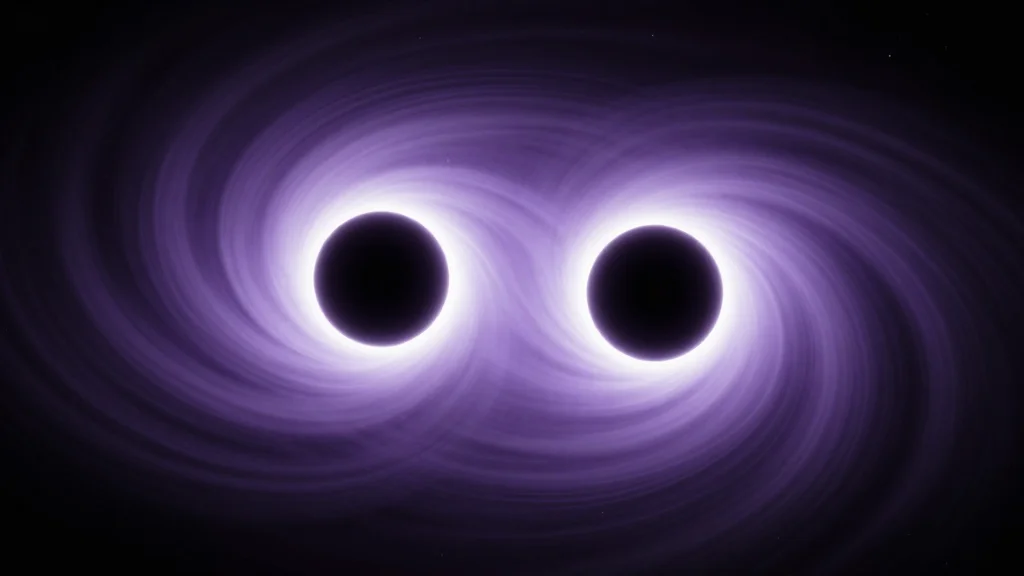
MIT Team Spots Possible Dark Matter Signature in Black‑Hole Merger GW190728

Why It Matters
Detecting dark matter through gravitational waves would provide a complementary approach to traditional astrophysical and laboratory searches, potentially confirming or ruling out classes of ultra‑light particle models. By leveraging existing observatories, the method sidesteps the need for new, costly detectors while expanding the scientific return of each merger event. Moreover, a confirmed imprint would validate superradiance as a real astrophysical process, reshaping our understanding of black‑hole physics and the interplay between gravity and quantum fields. Beyond particle physics, the technique could transform how we interpret the growing catalog of gravitational‑wave events. Each merger would become a probe of its local environment, offering insights into the distribution of dark matter on sub‑galactic scales and informing cosmological models that rely on dark‑matter clustering. The interdisciplinary nature of the work also strengthens ties between the LVK collaboration, theoretical physicists, and the broader astronomy community.
Key Takeaways
- •MIT and European team developed analytic templates for dark‑matter‑induced waveform distortions.
- •Analysis of 28 LVK events found one candidate, GW190728, showing a possible dark‑matter signature.
- •The method relies on superradiance of ultra‑light scalar particles around spinning black holes.
- •Results published in *Physical Review Letters*; authors stress it is a hint, not a detection.
- •Future LVK observing runs will test the approach on a larger sample of mergers.
Pulse Analysis
The MIT‑led study arrives at a moment when the gravitational‑wave community is seeking fresh science cases to justify the next generation of detectors. Historically, GW observations have confirmed general relativity and measured black‑hole populations; now they may also become a dark‑matter laboratory. This shift mirrors the early days of neutrino astronomy, where a single detection opened an entire field. If the GW190728 hint holds up, it could trigger a wave of theoretical work refining superradiance models and motivate targeted searches for specific scalar masses.
From a competitive standpoint, the technique gives the LVK network a unique edge over electromagnetic surveys that struggle with line‑of‑sight contamination. It also positions the collaboration as a key player in particle‑physics frontier research, potentially attracting funding streams traditionally reserved for collider experiments. However, the approach hinges on high‑signal‑to‑noise events and precise waveform modeling; systematic uncertainties in detector calibration or astrophysical noise could masquerade as dark‑matter effects. The community will likely demand independent verification, perhaps using data from the upcoming Einstein Telescope or Cosmic Explorer, which promise order‑of‑magnitude sensitivity gains.
Looking forward, the real test will be statistical: can the method isolate a population‑level excess that correlates with expected dark‑matter density gradients in galaxies? If so, gravitational‑wave astronomy could evolve from a purely relativistic probe to a dual‑purpose observatory, simultaneously mapping spacetime ripples and the invisible scaffolding of the cosmos. The next few years will reveal whether this promise translates into a paradigm shift or remains an intriguing footnote.
MIT Team Spots Possible Dark Matter Signature in Black‑Hole Merger GW190728
Comments
Want to join the conversation?
Loading comments...