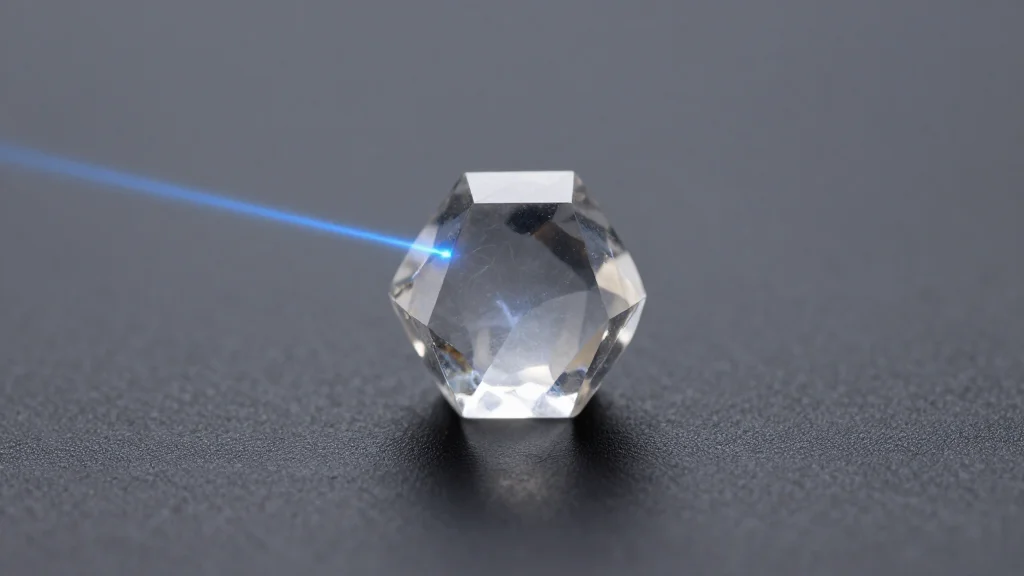
Molecule-in-a-Crystal System Could Boost Quantum Computing via Chemically Engineered Qubits
Why It Matters
The approach offers a chemically tunable, precisely placed qubit that could accelerate the development of scalable quantum processors and long‑distance quantum communication. Its superior coherence and optical stability address key bottlenecks in current solid‑state quantum hardware.
Key Takeaways
- •Carbene molecule embedded in crystal acts as controllable qubit
- •Spin coherence persists tens of milliseconds at 4.5 K
- •Bright, stable photon emission lasts over an hour
- •Chemical tuning enables precise placement versus defect-based qubits
Pulse Analysis
Defect‑based qubits, such as nitrogen‑vacancy centers in diamond, have driven much of the quantum‑hardware narrative because their electron spins can interface with photons. However, their stochastic formation within the crystal lattice makes deterministic placement difficult, limiting the ability to fabricate dense, multi‑qubit architectures. Researchers have long sought a platform that combines the optical addressability of defects with the manufacturing precision of semiconductor processes.
The NVision team’s molecule‑in‑a‑crystal system sidesteps these constraints by using synthetic chemistry to embed a carbene precursor into a host ketone crystal. Light‑induced conversion creates a stable carbene whose spin can be optically initialized, manipulated, and read out. Remarkably, the spin retains coherence for tens of milliseconds at cryogenic temperatures—a benchmark that surpasses many existing solid‑state qubits—while the molecule emits a bright, narrow‑band photon stream continuously for more than an hour. This dual performance of long‑lived spin states and reliable photon emission is essential for building spin‑photon interfaces that link distant quantum nodes.
If the chemistry can be extended to pattern arrays of such molecular qubits on a chip, the technology could enable deterministic entanglement and scalable quantum processors. Moreover, the ability to fine‑tune molecular structure offers a versatile toolbox for optimizing transition frequencies, coupling strengths, and decoherence pathways, potentially accelerating the integration of quantum hardware with existing photonic infrastructure. While still in the laboratory stage, this chemically engineered qubit platform marks a significant step toward practical quantum computing and secure quantum communication networks.
Molecule-in-a-crystal system could boost quantum computing via chemically engineered qubits
Comments
Want to join the conversation?
Loading comments...