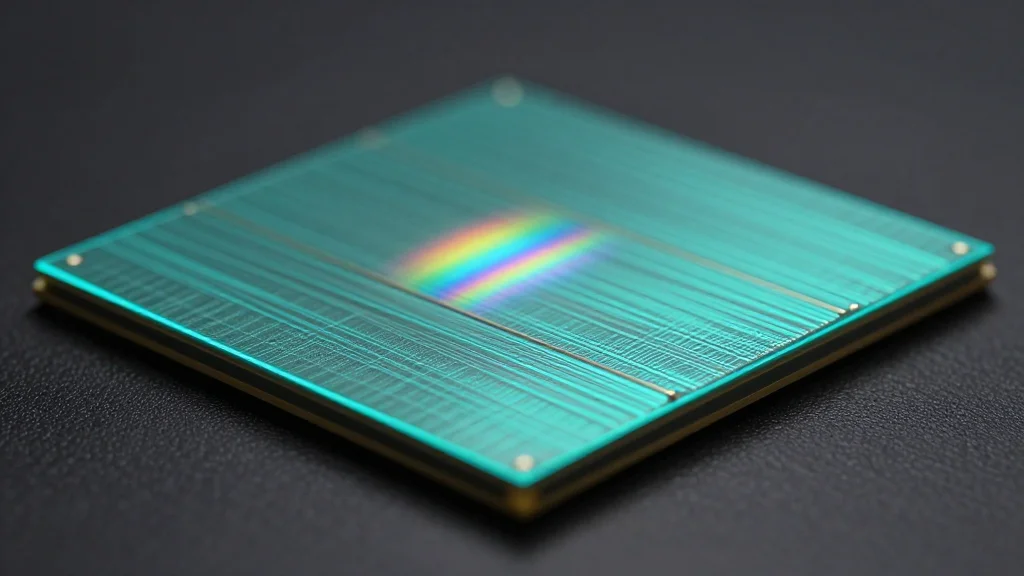
Monolithic 3D Integration of Tantalum Pentoxide Nonlinear Photonics
Why It Matters
The breakthrough compresses nonlinear photonic functionality into a compact, manufacturable form factor, accelerating deployment in data‑center interconnects, quantum processors, and next‑generation sensing systems.
Key Takeaways
- •Monolithic 3D stack merges Ta2O5 core with SiO2 cladding
- •Propagation loss <0.08 dB/cm; Kerr coefficient >1×10⁻¹⁸ m²/W
- •On‑chip octave‑spanning frequency combs achieved in sub‑mm footprint
- •CMOS‑compatible process enables wafer‑scale photonic foundry production
Pulse Analysis
Nonlinear photonics has long relied on materials such as silicon nitride and lithium niobate, which offer respectable Kerr coefficients but often require complex heterogeneous bonding or suffer from higher propagation loss. Tantalum pentoxide, a high‑index amorphous oxide, combines a large third‑order susceptibility with a wide transparency window from visible to mid‑infrared, making it an attractive alternative for on‑chip frequency conversion and comb generation. Recent advances in deposition techniques have reduced film stress and enabled precise thickness control, paving the way for its integration into dense photonic architectures.
The newly demonstrated monolithic 3D integration technique deposits a Ta₂O₅ core layer directly onto a silicon wafer, then caps it with silicon dioxide in a single, CMOS‑compatible sequence. By engineering the waveguide geometry and employing a photonic Damascene process, the team achieved propagation losses under 0.08 dB/cm—among the lowest reported for high‑index oxides—and a Kerr nonlinear index surpassing 1×10⁻¹⁸ m²/W. These metrics translate into efficient four‑wave mixing and enable octave‑spanning Kerr frequency combs in resonators only a few hundred micrometers long, rivaling the performance of bulk lithium niobate devices while occupying a fraction of the area.
The implications for the photonics industry are significant. A monolithic, wafer‑scale platform eliminates the need for costly alignment and bonding steps, reducing both capital expenditure and time‑to‑market for advanced optical modules. High‑density nonlinear circuits can now be co‑fabricated with passive routing, modulators, and detectors, supporting compact transceivers for data‑center links, integrated quantum light sources, and on‑chip LIDAR. As foundries adopt this process, designers will gain access to a versatile material palette that bridges the gap between low‑loss passive platforms and high‑performance nonlinear functionality, accelerating the commercialization of next‑generation photonic systems.
Monolithic 3D integration of tantalum pentoxide nonlinear photonics
Comments
Want to join the conversation?
Loading comments...