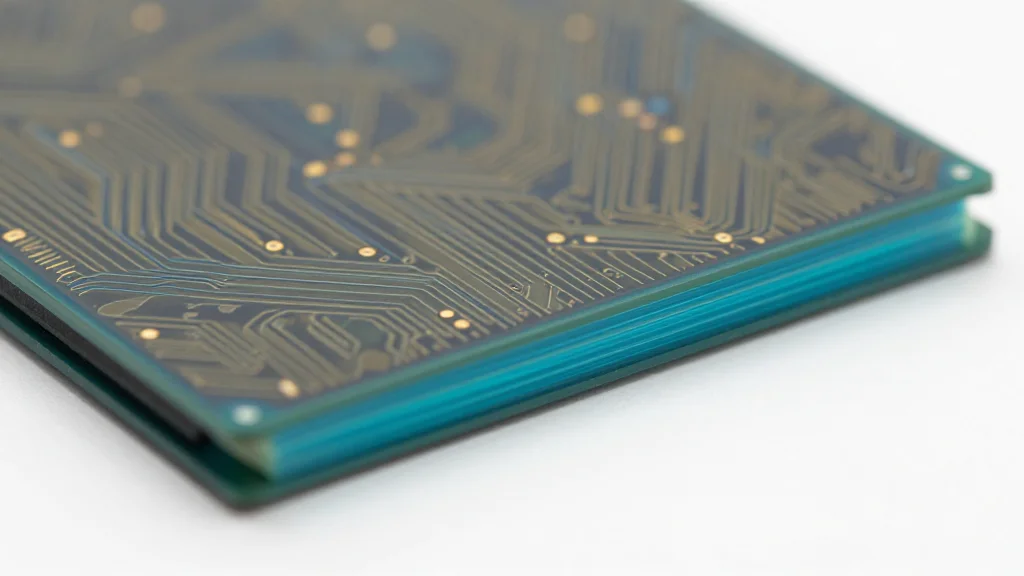
Monolithic 3D Tantalum Pentoxide Nonlinear Photonics
Why It Matters
The breakthrough removes long‑standing material‑compatibility barriers, paving the way for scalable, high‑performance photonic processors that can replace or augment electronic components in bandwidth‑critical markets.
Key Takeaways
- •Monolithic 3D tantala on lithium niobate achieved wafer‑scale fabrication
- •Low‑loss tantala resonators enable χ³ nonlinear processes like frequency combs
- •Integrated χ²/χ³ coupling allows cascaded frequency conversion on chip
- •Room‑temperature deposition preserves underlying circuits, simplifying manufacturing
- •3D interlayer routing increases density while minimizing cross‑talk
Pulse Analysis
The integration of tantalum pentoxide onto lithium‑niobate marks a decisive shift from fragmented hybrid photonics toward a unified material stack. By exploiting tantala’s low residual stress and room‑temperature deposition, engineers can grow thick, high‑quality films directly on pre‑patterned circuits without damaging delicate electro‑optic layers. This eliminates the alignment and thermal‑mismatch challenges that have hampered previous attempts, enabling full‑wafer processing and dramatically reducing production complexity.
Beyond the manufacturing advantage, the new platform delivers exceptional optical performance. High‑Q microresonators carved from tantala exhibit sub‑dB/cm propagation loss, supporting strong χ³ nonlinearities such as four‑wave mixing, supercontinuum generation, and dark‑pulse micro‑comb operation. Coupled with the χ² response of periodically poled lithium‑niobate beneath, the stack enables cascaded processes—frequency doubling followed by parametric oscillation—within a single chip footprint. These capabilities open pathways for on‑chip wavelength conversion, broadband sources, and quantum‑grade photon‑pair generation, all critical for next‑generation telecom, LIDAR, and quantum‑information hardware.
From a market perspective, the ability to produce dense, multilayer photonic circuits at wafer scale aligns with the escalating demand for high‑bandwidth, low‑latency interconnects in data centers and emerging AI accelerators. The reduced packaging overhead and compatibility with existing silicon‑photonic foundries lower the barrier to commercial adoption. As the industry seeks to push optical functionality deeper into system‑on‑chip designs, this monolithic 3‑D tantala‑lithium‑niobate architecture offers a versatile foundation for scalable, multifunctional photonic processors that could accelerate the transition from electronic to photonic computing paradigms.
Monolithic 3D Tantalum Pentoxide Nonlinear Photonics
Comments
Want to join the conversation?
Loading comments...