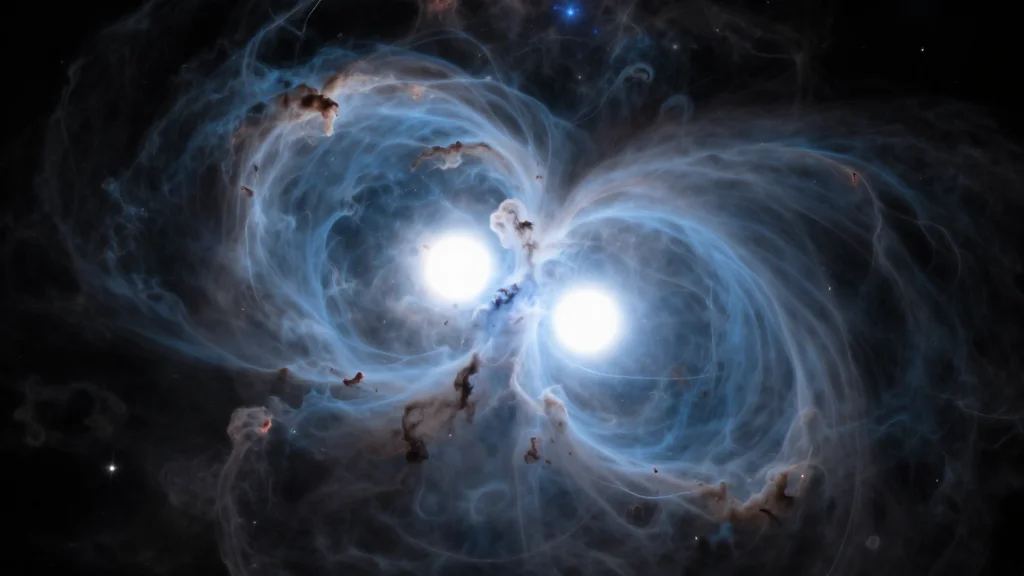
Most Close Pairs of Stars Are Born as Cosmic Twins
Why It Matters
Understanding how close binary stars originate refines star‑formation theory and improves predictions for planet formation in binary systems, a key factor for future exoplanet missions.
Key Takeaways
- •ALMA surveyed 100 close binary protostars across 5 star‑forming regions
- •~70% of close pairs share identical masses, indicating twin birth
- •Fragmentation of a single collapsing core explains most twin formations
- •Capture scenarios now account for less than 30% of close binaries
- •Findings reshape models of planet formation around binary stars
Pulse Analysis
Binary star systems dominate the Milky Way, yet astronomers have debated whether close pairs arise from mutual capture or simultaneous birth. Traditional capture models suggested that two independently formed stars could become bound through dynamical interactions in dense clusters. However, recent high‑resolution observations with the Atacama Large Millimeter/submillimeter Array (ALMA) and the Very Large Array (VLA) have provided unprecedented detail on the earliest stages of stellar evolution, allowing scientists to directly test these competing theories.
In the latest NRAO‑led survey, researchers targeted 100 protostellar pairs separated by less than 100 astronomical units. By measuring the mass ratios, orbital orientations, and surrounding gas structures, they discovered that about 70% of the systems exhibit near‑equal masses and aligned disks—signatures of a shared origin from a single, fragmenting molecular core. The remaining 30% display mismatched masses and misaligned disks, consistent with later gravitational capture. This statistical split overturns the previous assumption that capture dominates close binary formation and underscores fragmentation as the primary pathway.
The implications extend beyond pure astrophysics. Binary stars influence the architecture of surrounding planetary systems, affecting planet stability and habitability zones. Accurate models of binary formation therefore improve forecasts for exoplanet surveys, especially missions like the James Webb Space Telescope and upcoming space‑based observatories. Moreover, the findings guide future theoretical work and inform the design of next‑generation interferometers aimed at probing even finer details of star‑forming regions. As the field moves toward a unified picture of stellar birth, these results mark a pivotal step in linking star formation to the broader narrative of planetary system evolution.
Most Close Pairs of Stars Are Born as Cosmic Twins
Comments
Want to join the conversation?
Loading comments...