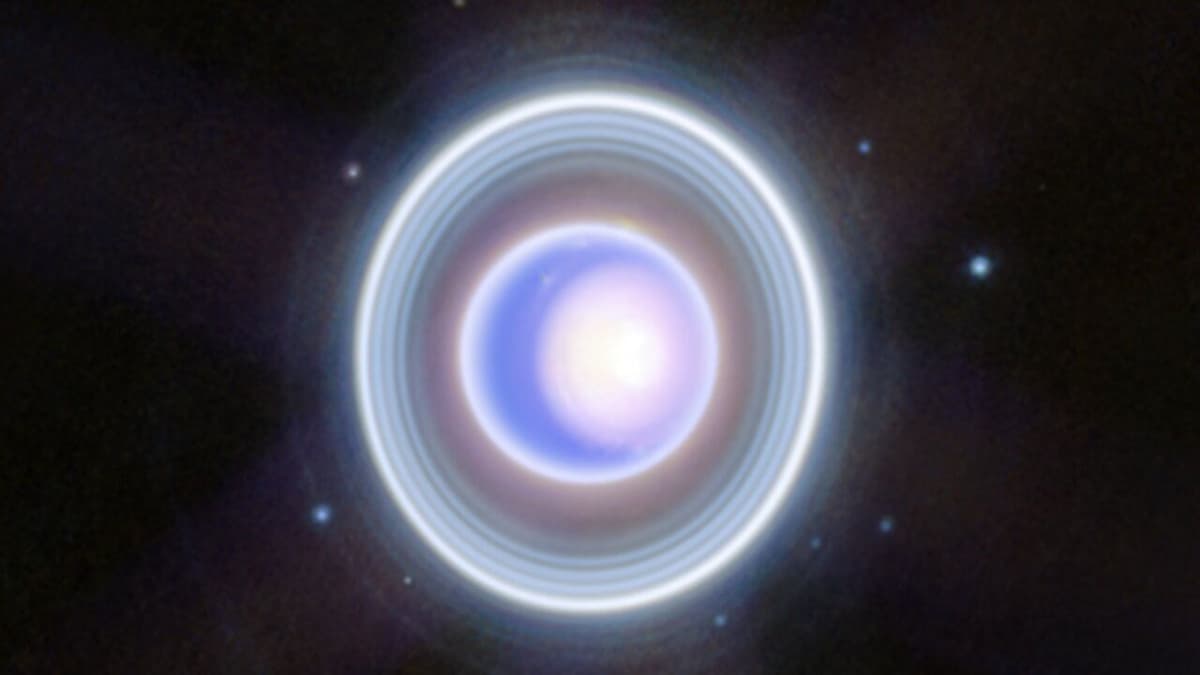
Mysterious Rings Around Uranus Point to Hidden Moons Orbiting the Ice Giant
Why It Matters
Understanding the distinct sources of Uranus’s outer rings refines models of moon‑ring interactions and planetary ring evolution across the solar system. The new evidence also bolsters support for a dedicated Uranus spacecraft, a top priority in the latest planetary science decadal survey.
Key Takeaways
- •JWST infrared data gave reflectance spectrum of Uranus’s μ and ν rings
- •μ‑ring’s water‑ice particles are sourced from 12‑km moon Mab
- •ν‑ring contains 10‑15% carbon‑rich organics, likely from unseen rocky moonlets
- •Color contrast shows distinct origins: icy cryovolcanic vs dusty impact debris
- •Results strengthen calls for a dedicated Uranus orbiter in upcoming decadal survey
Pulse Analysis
The James Webb Space Telescope’s infrared capabilities have finally unlocked a full reflectance spectrum for Uranus’s faint outer rings, a feat impossible with earlier visible‑light observations alone. By merging JWST data with Hubble and Keck measurements, researchers confirmed that the μ‑ring’s blue hue stems from pure water‑ice particles, mirroring Saturn’s E‑ring that is fed by Enceladus’s cryovolcanic plumes. In contrast, the ν‑ring’s reddish tint reveals a substantial fraction of carbon‑rich organics, pointing to a different, dust‑dominated source. This spectral dichotomy provides a rare laboratory for comparing icy and dusty ring formation processes within a single planetary system.
The compositional split implies that Uranus’s ring‑moon ecosystem is more complex than previously thought. The μ‑ring’s material can be directly linked to the tiny moon Mab, whose icy ejecta likely arise from micrometeoroid impacts or sublimation. Meanwhile, the ν‑ring appears to be sustained by collisions among yet‑unseen rocky moonlets that release organic‑laden dust when struck. Such mechanisms echo broader solar‑system dynamics, where ring particles often trace back to active satellites, informing models of satellite erosion, surface chemistry, and the long‑term evolution of circumplanetary debris disks. Recognizing these distinct pathways sharpens our understanding of how rings can persist, transform, or dissipate over geological timescales.
These revelations arrive as the planetary science community pushes for a dedicated Uranus mission, highlighted as the top priority in the most recent Decadal Survey. Close‑up imaging and in‑situ measurements could confirm the hidden moonlets, map ring particle size distributions, and test hypotheses about cryovolcanic versus impact‑driven sourcing. Beyond Uranus, such a mission would fill a critical gap in comparative planetology, linking the icy giants of our system and refining theories of moon formation around exoplanets. The new JWST findings therefore not only deepen our grasp of Uranus’s rings but also strengthen the case for the next generation of outer‑planet exploration.
Mysterious rings around Uranus point to hidden moons orbiting the ice giant
Comments
Want to join the conversation?
Loading comments...