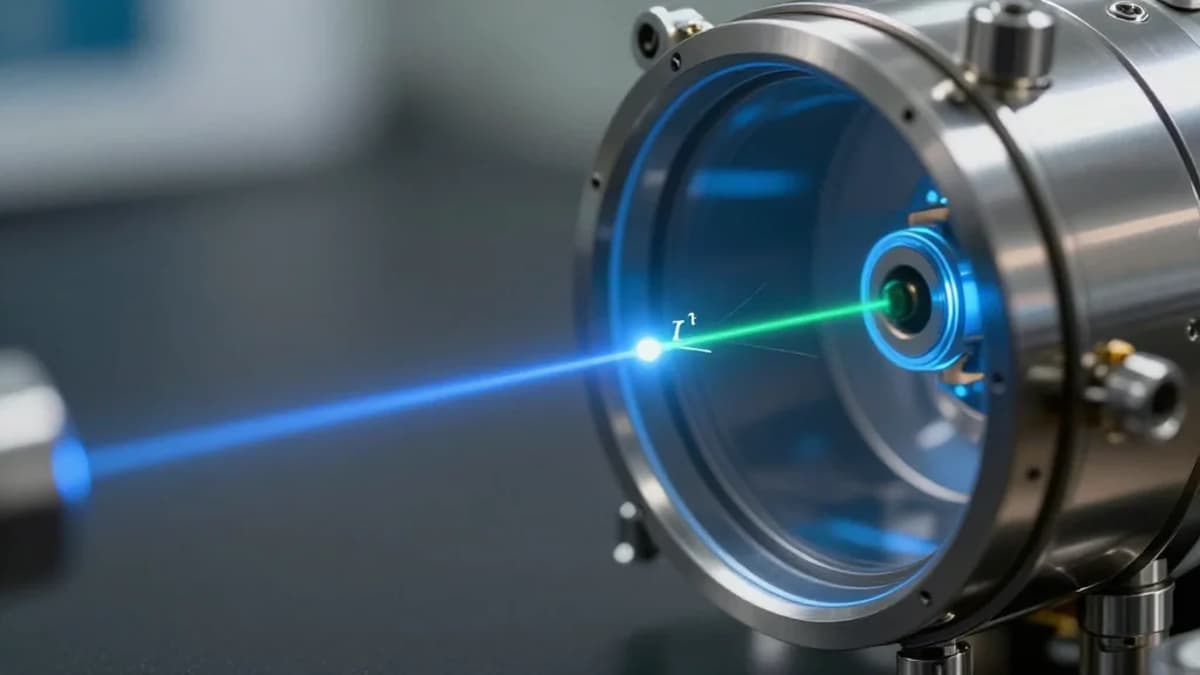
NA62 Collaboration Refines Measurement of Rare Particle Decay
•March 4, 2026
0
Why It Matters
By tightening the branching‑ratio uncertainty, NA62 sharply limits the parameter space for new physics, strengthening confidence in the Standard Model and guiding future theoretical work.
Key Takeaways
- •NA62 reduces branching ratio uncertainty by 40%
- •Updated K+→π+νν value: 9.6×10⁻¹¹
- •Result matches Standard Model predictions, limiting new physics
- •Machine learning improves analysis of ultra‑rare decays
- •Kaon factory yields billions of particles per second
Pulse Analysis
Rare kaon decays have long been a cornerstone for testing the Standard Model because their theoretical predictions are exceptionally clean. The K⁺→π⁺νν channel, occurring in fewer than one in ten billion kaon decays, offers a direct window into potential contributions from undiscovered particles. NA62’s high‑intensity proton beam on a beryllium target creates a prolific kaon source, enabling the experiment to collect enough events to confront theory with unprecedented precision.
The latest NA62 results cut the uncertainty on the branching ratio by 40%, thanks to the integration of 2023‑2024 data and sophisticated machine‑learning algorithms that enhance signal‑background discrimination. This tighter measurement not only confirms the Standard Model’s prediction but also squeezes the viable space for extensions such as supersymmetry or dark sector models. Compared with the 2024 five‑sigma observation, the new analysis delivers a more robust statistical foundation, allowing physicists to set stronger limits on exotic couplings that could have manifested in this decay.
Beyond the immediate physics impact, the methodological advances demonstrate how artificial intelligence can accelerate discovery in high‑energy experiments. Improved data pipelines and real‑time pattern recognition are becoming essential tools for future colliders and precision experiments. As the community pushes toward even rarer processes, the NA62 experience underscores the synergy between cutting‑edge detector technology, massive data volumes, and AI‑driven analysis, shaping the roadmap for the next generation of particle‑physics research.
NA62 Collaboration refines measurement of rare particle decay
0
Comments
Want to join the conversation?
Loading comments...