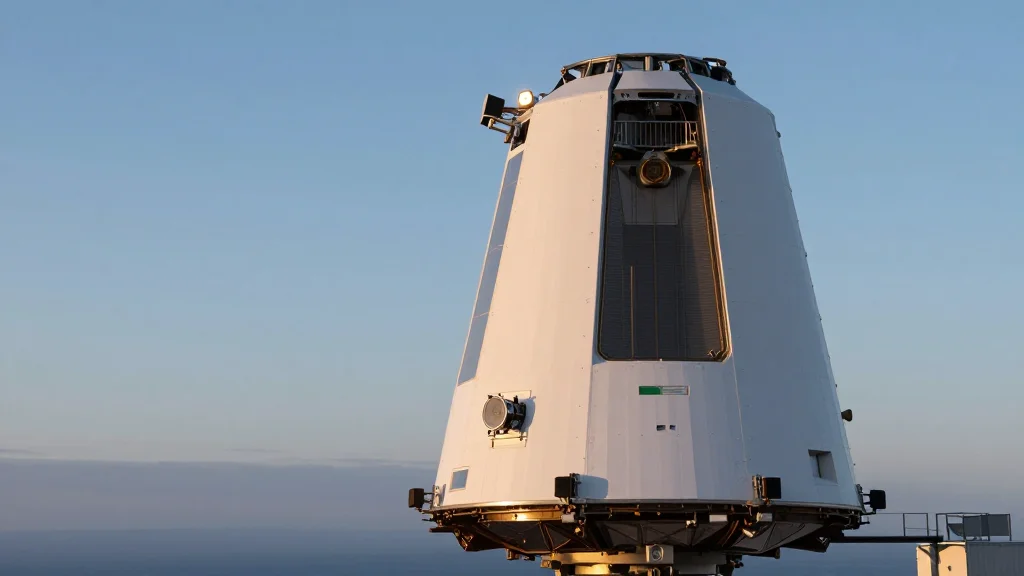
NASA Completes Roman Space Telescope, Prepares for Launch to Map Dark Energy and Exoplanets

Companies Mentioned

NASA
Why It Matters
The Roman Space Telescope represents a paradigm shift in how astronomers study the universe. Its wide‑field infrared surveys will dramatically increase the statistical sample of supernovae, galaxy clusters and weak‑lensing measurements, sharpening constraints on dark energy and potentially revealing cracks in the standard cosmological model. Simultaneously, the coronagraph’s ability to directly image exoplanets opens a new frontier in the search for habitable worlds, feeding into the broader quest to answer whether life exists elsewhere. Beyond pure science, Roman’s success will validate large‑scale, cost‑effective space observatories, influencing future mission designs and international collaborations. The data set will be a public resource for decades, enabling discoveries that extend far beyond the mission’s original goals and cementing the United States’ leadership in space‑based astrophysics.
Key Takeaways
- •Roman Space Telescope fully assembled at Goddard after >10 years of development
- •40‑foot tall, 0.28‑square‑degree field of view—~100× Hubble’s
- •One month of Roman observations equals a century of Hubble data, per Julie McEnery
- •Carries a high‑stability coronagraph for direct exoplanet imaging, per Vanessa Bailey
- •Program executive Lucas Paganini says Roman will survey huge sky areas to address fundamental cosmology
Pulse Analysis
Roman’s readiness signals a strategic pivot for NASA toward survey‑driven astrophysics. While flagship missions like JWST focus on depth, Roman emphasizes breadth, delivering a statistical trove that can resolve tensions in measurements of the Hubble constant and the equation of state of dark energy. The telescope’s design leverages heritage from Hubble and the Wide‑Field Infrared Survey Telescope (WFIRST) concept, but with modernized optics and a more robust coronagraph, reflecting lessons learned from past cost overruns and schedule delays.
From a competitive standpoint, the European Space Agency’s Euclid mission, slated for launch in 2025, will also map dark energy using a different wavelength regime. Roman’s infrared capabilities and higher resolution will complement Euclid’s optical surveys, fostering a de‑facto global partnership that could set new standards for data sharing and joint analysis. The overlap will enable cross‑validation of cosmological parameters, reducing systematic uncertainties that have plagued earlier studies.
Looking ahead, the success of Roman could catalyze a new generation of wide‑field space telescopes, potentially including concepts for a "Super‑Roman" or a dedicated exoplanet imaging platform. The mission’s public data policy will democratize access, allowing university teams and citizen scientists to mine the archives for unexpected phenomena. If Roman delivers on its promise, it will not only reshape our understanding of the universe’s expansion but also demonstrate that large‑scale, cost‑controlled space observatories are viable, encouraging both governmental and commercial stakeholders to invest in similar ventures.
NASA Completes Roman Space Telescope, Prepares for Launch to Map Dark Energy and Exoplanets
Comments
Want to join the conversation?
Loading comments...