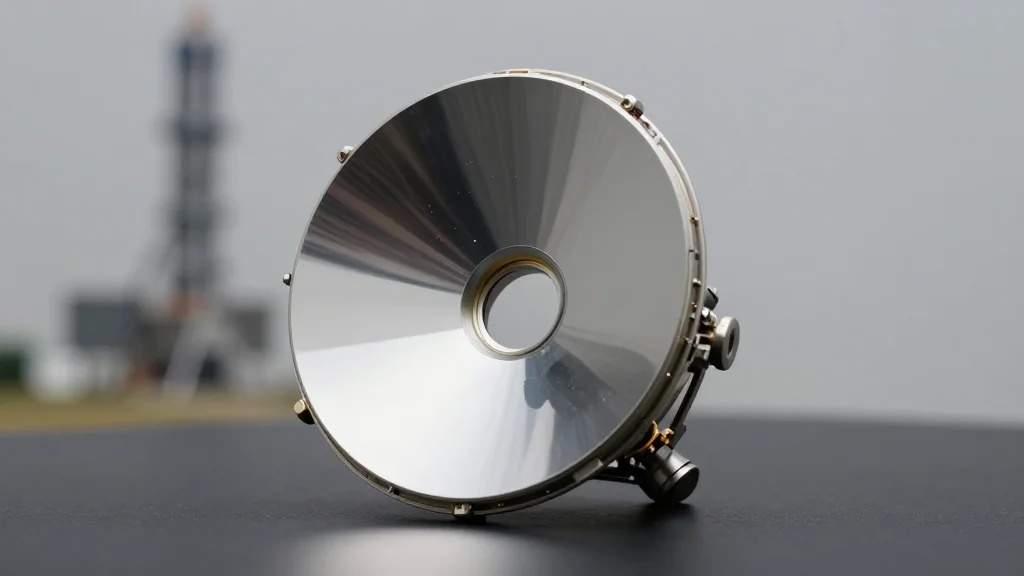
NASA Confirms Roman Telescope’s 2.5‑Meter Mirror Passes Final Inspection

Companies Mentioned

Why It Matters
The Roman Space Telescope represents the most ambitious wide‑field infrared survey mission since the Hubble era. By confirming the primary mirror’s integrity, NASA removes a key technical risk and solidifies the timeline for a mission that could deliver the most precise measurements of dark energy to date. The data will feed into cosmological models, potentially confirming or challenging the current ΛCDM paradigm. Beyond cosmology, Roman’s exoplanet coronagraph will provide the first direct images of Earth‑size planets in reflected light, a capability that will inform the design of future flagship missions such as the Habitable Worlds Observatory. The successful inspection therefore accelerates a cascade of scientific opportunities across multiple disciplines, from galaxy evolution to the search for life beyond Earth.
Key Takeaways
- •NASA confirmed the 2.5‑meter primary mirror passed its final visual inspection
- •Inspection took place at NASA Goddard in Greenbelt, Maryland
- •Mirror coating is a 400‑nm silver layer, 200× thinner than a human hair
- •Mission remains on schedule for an early‑September launch
- •Roman will map dark energy and directly image exoplanets
Pulse Analysis
Roman’s mirror clearance is more than a procedural checkpoint; it signals that NASA’s flagship survey telescope is entering the final, high‑stakes phase of integration. Historically, large‑aperture space telescopes have suffered schedule slips when optical components required rework after vibration testing—Hubble’s original mirror flaw being the most infamous example. By completing a comprehensive visual inspection after the full suite of environmental tests, NASA demonstrates that its quality‑control processes have matured, reducing the likelihood of costly post‑test fixes.
From a competitive standpoint, Roman positions the United States ahead of emerging international survey projects such as the European Space Agency’s Euclid and China’s planned Wide‑Field Survey Telescope. While Euclid focuses on optical and near‑infrared imaging for dark energy, Roman’s larger field of view and dedicated coronagraph give it a distinct scientific edge. The successful mirror inspection therefore not only safeguards the mission’s timeline but also reinforces U.S. leadership in space‑based astrophysics.
Looking forward, the cleared mirror opens the door for the next wave of data‑driven discoveries. Early‑release survey data, expected within two years of launch, will feed machine‑learning pipelines that can identify transient phenomena, map large‑scale structure and refine exoplanet occurrence rates. The scientific community is already preparing to integrate Roman’s datasets with those from the Vera C. Rubin Observatory and the James Webb Space Telescope, creating a multi‑wavelength synergy that could finally pin down the nature of dark energy and expand the catalog of potentially habitable worlds. The mirror’s green light thus marks the beginning of a new era of precision cosmology and exoplanet science.
NASA Confirms Roman Telescope’s 2.5‑Meter Mirror Passes Final Inspection
Comments
Want to join the conversation?
Loading comments...