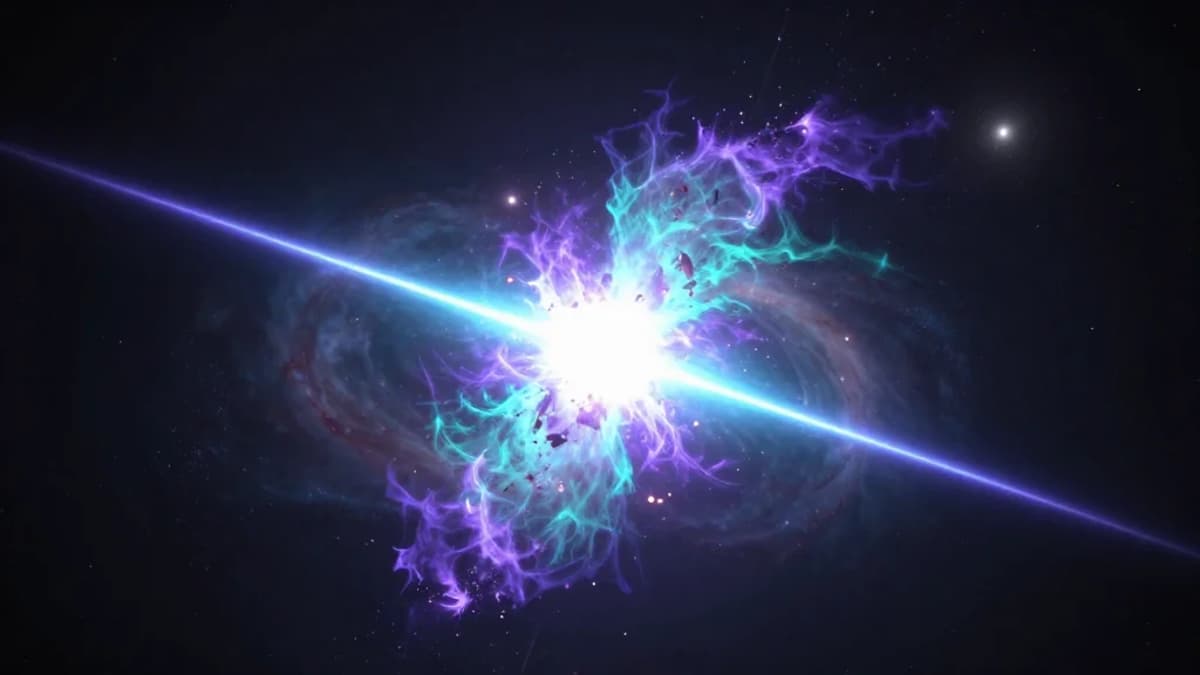
NASA Discovers Crash of Extreme Stars in Unexpected Site
•March 11, 2026
0
Why It Matters
The finding forces a reevaluation of where extreme stellar mergers can happen, impacting predictions of gravitational‑wave event rates and heavy‑element synthesis. It also provides a new laboratory for testing relativistic physics in low‑density environments.
Key Takeaways
- •X‑ray telescopes captured unprecedented neutron‑star collision
- •Event located in galaxy halo, not central region
- •Kilonova emitted, confirming heavy‑element formation
- •Challenges models of star formation in sparse space
- •Will refine neutron‑star merger rate estimates
Pulse Analysis
The unexpected site of the neutron‑star crash reshapes astronomers' understanding of where such cataclysmic events can occur. Traditionally, dense stellar environments like galactic cores or globular clusters have been considered prime locations for binary mergers. However, Chandra’s detection of a high‑energy X‑ray flash originating from a galaxy’s outer halo suggests that binary systems can survive and eventually coalesce even in low‑density regions. This insight compels theorists to revisit population‑synthesis models, accounting for longer orbital decay times and alternative formation pathways that operate far from the gravitational well of a galaxy.
Beyond the astrophysical intrigue, the merger’s multi‑messenger signature—combining X‑ray, optical kilonova, and potential gravitational‑wave signals—offers a rare, holistic view of the physics governing extreme matter. The kilonova’s spectral fingerprints indicate rapid r‑process nucleosynthesis, contributing to the cosmic abundance of gold, platinum, and other heavy elements. By correlating the X‑ray light curve with gravitational‑wave data, scientists can tighten constraints on the equation of state of ultra‑dense nuclear matter, a long‑standing question in high‑energy physics.
Looking forward, the discovery underscores the importance of coordinated observation networks that span the electromagnetic spectrum and gravitational‑wave detectors. It also highlights the need for next‑generation X‑ray observatories with higher sensitivity to capture faint, distant events. As more off‑center mergers are identified, the statistical sample will improve, refining estimates of merger rates and informing the design of future space‑based interferometers. In short, this breakthrough not only expands the map of where the universe’s most violent collisions happen but also enriches the toolkit for probing fundamental physics.
NASA Discovers Crash of Extreme Stars in Unexpected Site
0
Comments
Want to join the conversation?
Loading comments...