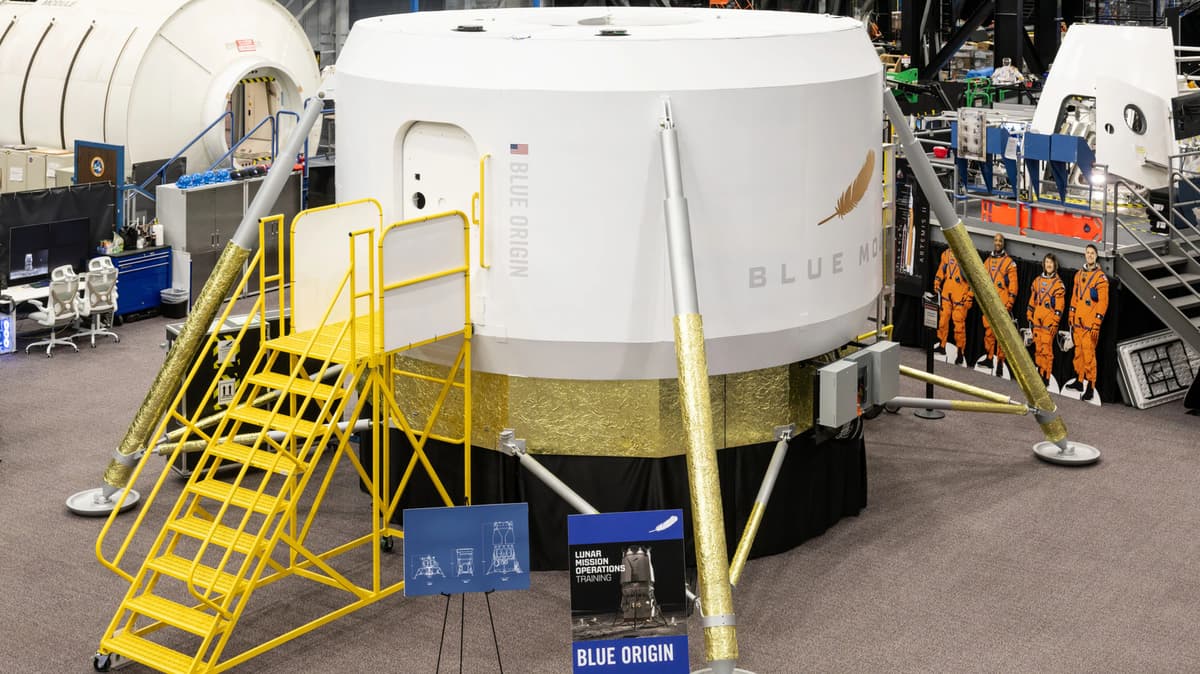
NASA Is Set to Begin Training with a Prototype of Blue Origin's Crew Moon Lander
Companies Mentioned


Why It Matters
The prototype enables NASA to validate crew operations and communications before the actual lander flies, reducing risk for the Artemis III deadline. It also deepens the commercial partnership model that underpins the next wave of lunar exploration.
Key Takeaways
- •NASA receives full‑scale Blue Origin crew cabin prototype for training.
- •Prototype enables human‑in‑the‑loop simulations, suit checkouts, and mission drills.
- •Blue Origin’s MK2 lander will stand 52 feet tall when fully assembled.
- •Artemis III targets 2027 lunar landing, testing dock with Blue Origin and SpaceX.
- •Uncrewed “Endurance” MK1 undergoing thermal‑vacuum tests for 2024 science payload mission.
Pulse Analysis
NASA’s Artemis program has shifted from proving concepts to building operational capability, and commercial partners are now at the heart of that transition. After Artemis II demonstrated crewed deep‑space flight, the agency turned to Blue Origin and SpaceX to supply the landers that will carry astronauts to the lunar surface. By integrating a full‑scale crew cabin prototype into Johnson Space Center’s training pipeline, NASA can rehearse every step of a Moon mission— from launch‑to‑orbit docking to suit donning and surface egress—under realistic conditions. This hands‑on approach helps identify human factors issues early, ensuring that the eventual flight hardware aligns with astronaut needs and mission timelines.
The Mark 2 cabin mock‑up, standing 15 feet tall, mirrors the interior of Blue Origin’s planned lunar lander, while the full vehicle will rise to roughly 52 feet when assembled. Engineers will run human‑in‑the‑loop tests that simulate communications with mission control, emergency procedures, and lunar EVA workflows. Such simulations are crucial because neither Blue Origin nor SpaceX has yet completed an actual Moon landing, and the agency’s 2028 landing goal leaves little margin for error. The prototype also serves as a testbed for integrating Orion’s docking interface, a key step for Artemis III, which aims to launch in 2027.
Beyond the immediate schedule, this collaboration signals a broader shift toward a commercial lunar economy. Blue Origin’s uncrewed “Endurance” (MK1) lander is already undergoing thermal‑vacuum testing for a 2024 science payload mission, laying groundwork for cargo deliveries that will support future crewed flights. As NASA validates crew operations on the prototype, confidence grows that private firms can meet the rigorous demands of deep‑space hardware, accelerating the timeline for sustained human presence on the Moon and paving the way for Mars‑bound missions.
NASA is set to begin training with a prototype of Blue Origin's crew moon lander
Comments
Want to join the conversation?
Loading comments...