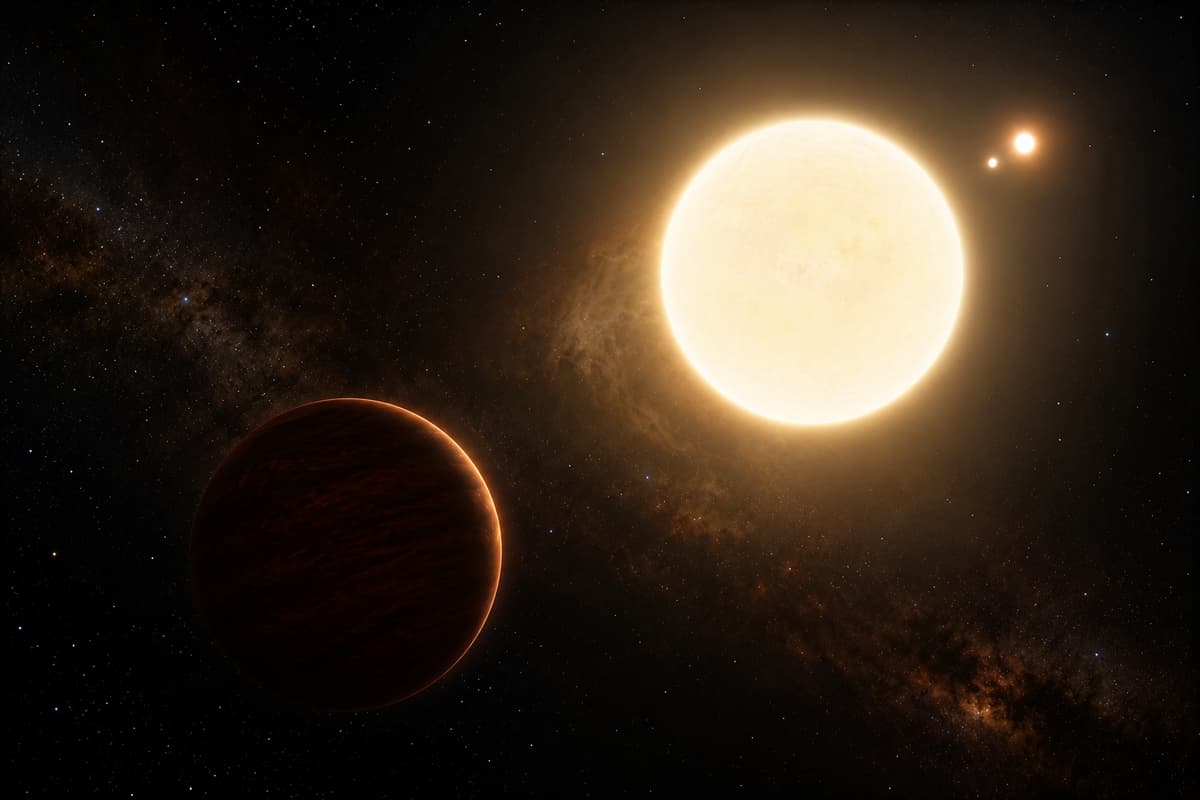
NASA Just Found a Star System That Can Pull Off a “Triple Eclipse” – Astronomers Even Ran the Simulation
Why It Matters
The system provides a natural laboratory for testing theories of multi‑star formation and orbital dynamics, and demonstrates TESS’s capability to uncover complex stellar architectures beyond exoplanets.
Key Takeaways
- •TIC 295741342: two Sun-like stars orbit a 1.7‑solar‑mass giant
- •Mutual orbital inclination is only 0.25‑0.33°, enabling rare triple eclipses
- •TESS detected the system via complex light‑curve dips, not exoplanets
- •Simulations show a “head‑and‑shoulders” brightness pattern as three suns sequentially vanish
- •Provides a test for disk‑fragmentation and migration models of multi‑star formation
Pulse Analysis
The discovery of TIC 295741342 underscores how space‑based photometry can reveal stellar arrangements that are virtually invisible from the ground. While TESS was designed to hunt for transiting exoplanets, its continuous, high‑precision monitoring of stellar brightness also captures the intricate dip patterns produced by multi‑star interactions. In this case, the light curve displayed a “head‑and‑shoulders” signature that could only arise when an inner eclipsing binary and an outer giant star align within a fraction of a degree, a geometric rarity that astronomers estimate occurs in less than one in a thousand triple systems.
From a theoretical standpoint, the near‑coplanar geometry of TIC 295741342 offers a stringent test for models of hierarchical star formation. The authors argue that such a flat configuration likely emerged from disk fragmentation followed by inward migration and gas dissipation, processes that are still debated in the context of massive star clusters. By reproducing the observed timing, depth, and shape of the triple eclipse through orbital simulations, the team validates key predictions about angular momentum transfer and orbital damping in young stellar nurseries. This empirical anchor helps refine simulations that aim to explain how multiple stars co‑evolve without destabilizing each other.
Looking ahead, the system opens new avenues for both stellar astrophysics and exoplanet science. A triple‑eclipse environment creates highly variable illumination conditions that could affect the climate of any circumbinary planets, offering a natural experiment for habitability studies. Moreover, the rarity of such alignments means that each new detection dramatically expands the statistical sample needed to calibrate population‑level models. Future missions with even finer photometric precision, such as the upcoming PLATO and Roman Space Telescope, may uncover dozens more of these exotic configurations, further illuminating the complex choreography of stars in our galaxy.
NASA Just Found a Star System That Can Pull Off a “Triple Eclipse” – Astronomers Even Ran the Simulation
Comments
Want to join the conversation?
Loading comments...