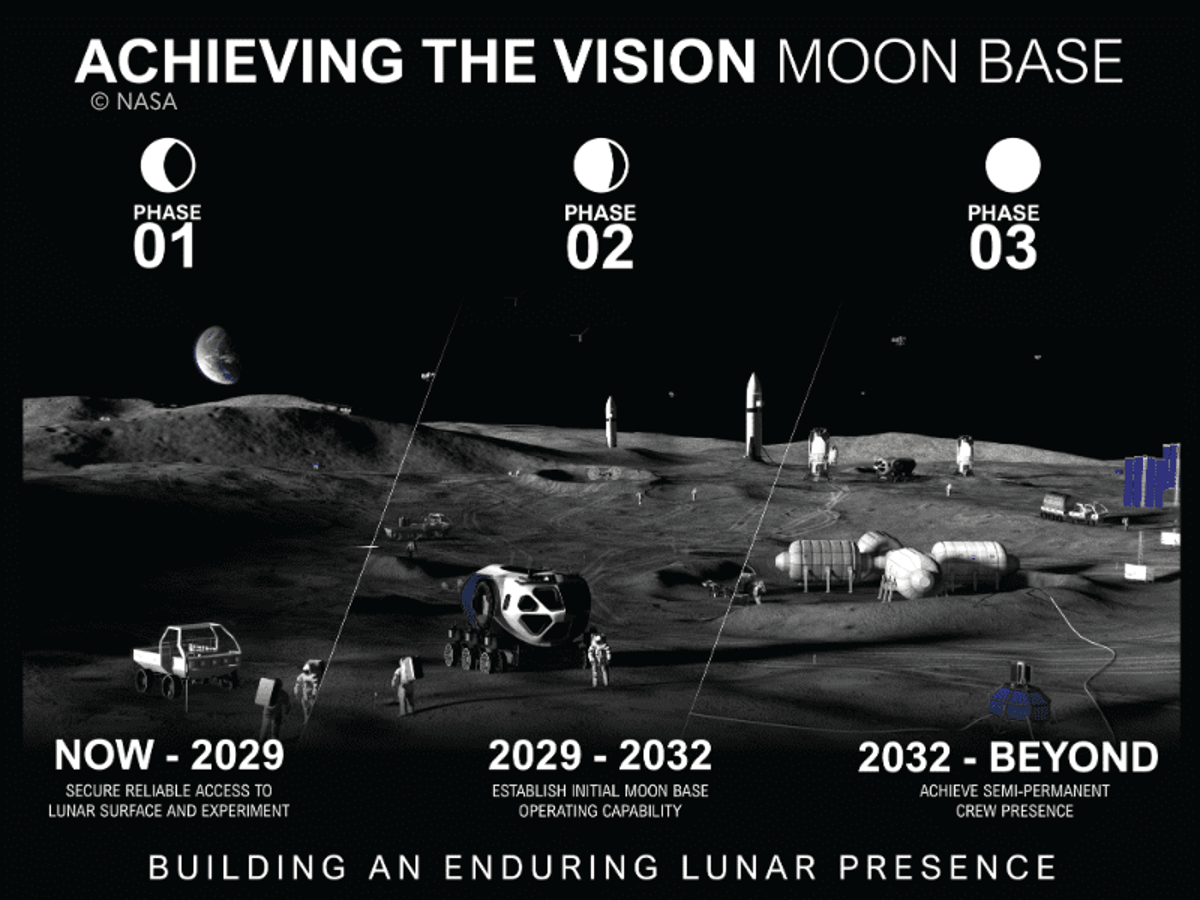
NASA Outlines Phased Plan for Permanent Moon Base
Companies Mentioned

Why It Matters
The plan positions the United States to secure strategic resources and technology leadership on the Moon, while delays could cede advantage to China’s faster lunar program.
Key Takeaways
- •NASA targets lunar south pole for sustained human presence.
- •Phase 1 (to 2029) will launch up to 25 robotic missions.
- •Phase 2 (2029‑2032) aims to deliver 60 tonnes via 24 landings.
- •Power strategy mixes solar arrays with potential surface fission reactors.
- •Competition with China intensifies as Starship delays risk timeline.
Pulse Analysis
The lunar south pole has become the focal point of next‑generation space exploration because its near‑continuous sunlight and suspected water‑ice deposits promise renewable power and in‑situ resource utilization. By anchoring a base in this region, NASA aims to tap a natural energy source and reduce the mass of supplies needed from Earth, a strategic advantage that could reshape the economics of deep‑space missions and spur a new market for lunar‑grade materials.
NASA’s three‑phase architecture spreads risk and leverages commercial expertise. Phase 1 emphasizes robotic scouting, deploying up to 25 landers, rovers and the novel MoonFall hopping drones to validate navigation, communications and radioisotope heater units. Phase 2 ramps up infrastructure, delivering 60 tonnes of cargo through 24 landings, installing expanded solar farms and testing surface fission reactors that could provide continuous power during the two‑week lunar night. Partnerships with Blue Origin, Astrobotic and Intuitive Machines illustrate a growing ecosystem of private firms ready to supply launch services, lander technology and autonomous surface systems.
The broader impact reaches beyond NASA’s scientific goals. A sustained lunar presence will drive demand for advanced semiconductors, radiation‑hard electronics and high‑efficiency energy storage—technologies that have terrestrial spin‑offs in renewable energy and autonomous vehicles. Geopolitically, the timeline pits the U.S. against China’s accelerating lunar program; any slip in the Starship Human Landing System could shift the balance of prestige and commercial contracts to Beijing. Consequently, investors and policymakers are watching the roadmap closely as a bellwether for the next wave of space‑related economic activity.
NASA outlines phased plan for permanent Moon base
Comments
Want to join the conversation?
Loading comments...